


Page 4 - July-Open-Access-2020
P. 4
TECHNICAL PAPER
3.1.2 Metakaolin and class F fly ash significant increase in the water demand, caused by the greater
quantity of very fine particles of calcined clay. As the quantity
metakaolins are rarely pure , the impurities depend on the of water is essential for geopolymers and alkali-activated
[5]
place of extraction and, like silico-aluminous CVs, they contain materials (see section 3.2), care must be taken to ensure a
very inactive crystallized phases of low solubility in a basic “purity-fineness-water demand” balance which optimizes the
medium. The main silico-aluminous phases of these materials rheological properties and the desired performances.
are an amorphous phase containing silica and alumina, and
crystallized phases such as quartz (siO ) and mullite (al si O ). 3.2 Focus on the main activators - which
2 6 2 13
Chemical analysis is not enough to characterize the potential activators can be used with a given precursor?
reactivity of the material because quartz and mullite are
practically inert in basic medium, despite the very high initial activators are necessary because the precursors used are latent
pH of the porous solution. It has been shown that the quartz hydraulic at best (GGBS, class C fly ash), at worst practically
[6]
initially present in the mK is not consumed by the sodium silicate inert in the presence of water at neutral pH. GGbs seems
solution, despite a pH above 13. It is therefore necessary to easier to activate than aluminosilicates probably because they
determine the proportion of reactive phase to avoid counting are latent hydraulics. The main alkaline salts (1 column of the
st
all of the silica and alumina as participating in the reaction. In periodic table) such as hydroxides, silicates, carbonates or
order to quantify the reactive phases, it is for example possible sulfates generally work with GGbs. The most common cations
to carry out dissolutions in basic medium, but the dissolved silica are sodium and potassium, the others are not generally used for
is unstable and easily reprecipitates, which makes it difficult to reasons of cost or danger (radioactive nature of Fr for example).
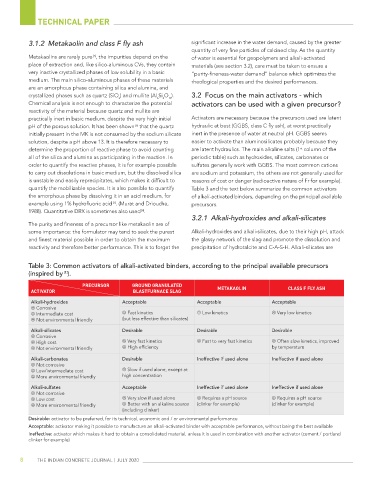
quantify the mobilizable species. It is also possible to quantify Table 3 and the text below summarize the common activators
the amorphous phase by dissolving it in an acid medium, for of alkali-activated binders, depending on the principal available
example using 1% hydrofluoric acid . (murat and Driouche, precursors.
[7]
1988). Quantitative DRX is sometimes also used .
[8]
3.2.1 Alkali-hydroxides and alkali-silicates
The purity and fineness of a precursor like metakaolin are of
some importance: the formulator may tend to seek the purest alkali-hydroxides and alkali-silicates, due to their high pH, attack
and finest material possible in order to obtain the maximum the glassy network of the slag and promote the dissolution and
reactivity and therefore better performance. This is to forget the precipitation of hydrotalcite and C-a-s-H. alkali-silicates are
Table 3: Common activators of alkali-activated binders, according to the principal available precursors
(inspired by ).
[1]
PRECURSOR GROUND GRANULATED
ACTIVATOR BLASTFURNACE SLAG METAKAOLIN CLASS F FLY ASh
Alkali-hydroxides Acceptable Acceptable Acceptable
Corrosive
Intermediate cost Fast kinetics Low kinetics Very low kinetics
Not environmental friendly (but less effective than silicates)
Alkali-silicates Desirable Desirable Desirable
Corrosive
High cost Very fast kinetics Fast to very fast kinetics Often slow kinetics, improved
Not environmental friendly High efficiency by temperature
Alkali-carbonates Desirable Ineffective if used alone Ineffective if used alone
Not corrosive
Low/intermediate cost slow if used alone, except at
more environmental friendly high concentration
Alkali-sulfates Acceptable Ineffective if used alone Ineffective if used alone
Not corrosive
Low cost Very slow if used alone Requires a pH source Requires a pH source
more environmental friendly better with an alkaline source (clinker for example) (clinker for example)
(including clinker)
Desirable: activator to be preferred, for its technical, economic and / or environmental performance
Acceptable: activator making it possible to manufacture an alkali-activated binder with acceptable performance, without being the best available
Ineffective: activator which makes it hard to obtain a consolidated material, unless it is used in combination with another activator (cement / portland
clinker for example)
8 The IndIan ConCreTe Journal | JulY 2020

