


Page 3 - July-Open-Access-2020
P. 3
TECHNICAL PAPER


           mK), while Portland cements are composed of water-soluble
           crystalline minerals.
           activated slags produce C-a-s-H , which is not the case for
                                      [3]
           metakaolins or fly ash, as aluminosilicates are composed of
           silica chains, with si-O-si and si-O-al bridges that form a three-
           dimensional network structure . The existence of chains of
                                    [4]
           atoms and crosslinking evokes that of organic carbon-based
           polymers (origin of the name “geopolymers”).

           Unlike Portland cement, which can practically be considered
           fully reactive (even if large grains never hydrate completely),
           precursors of GP and aab often have lower amounts of reactive
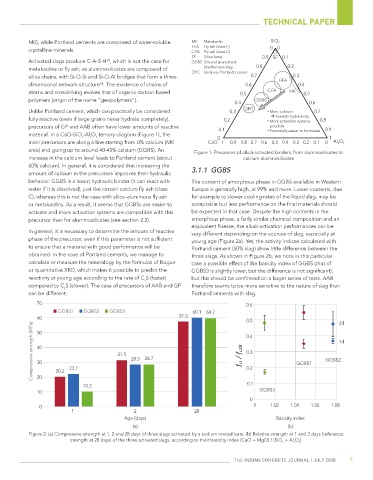
           material. In a CaO-siO -al O  ternary diagram (Figure 1), the
                             2  2  3
           main precursors are along a line starting from 0% calcium (mK
           area) and going up to around 40-45% calcium (GGbs). an   Figure 1: Precursors of alkali-activated binders: from aluminosilicates to
           increase in the calcium level leads to Portland cement (about           calcium aluminosilicates
           60% calcium). In general, it is considered that increasing the
           amount of calcium in the precursors improves their hydraulic   3.1.1  GGBS
           behavior. GGbs is a latent hydraulic binder (it can react with   The content of amorphous phase in GGbs available in Western
           water if it is dissolved), just like certain calcium fly ash (class   Europe is generally high, at 99% and more. Lower contents, due
           C), whereas this is not the case with silico-aluminous fly ash   for example to slower cooling rates of the liquid slag, may be
           or metakaolins. as a result, it seems that GGbss are easier to   acceptable but less performance on the final materials should
           activate and more activation systems are compatible with this   be expected in that case. Despite the high contents in the
           precursor than for aluminosilicates (see section 2.2).  amorphous phase, a fairly similar chemical composition and an
                                                                  equivalent finesse, the alkali-activation performances can be
           In general, it is necessary to determine the amount of reactive   very different depending on the sources of slag, especially at
           phase of the precursor, even if this parameter is not sufficient   young age (Figure 2a). Yet, the activity indices calculated with
           to ensure that a material with good performance will be   Portland cement (50% slag) show little difference between the
           obtained. In the case of Portland cements, we manage to   three slags. as shown in Figure 2b, we note in this particular
           calculate or measure the mineralogy by the formulas of bogue   case a possible effect of the basicity index of GGbs (that of
           or quantitative XRD, which makes it possible to predict the   GGBS3 is slightly lower, but the difference is not significant),
           reactivity at young age according to the rate of C s (faster)   but this should be confirmed on a larger series of tests. AAB
                                                  3
           compared to C s (slower). The case of precursors of aab and GP   therefore seems to be more sensitive to the nature of slag than
                       2
           can be different:                                      Portland cements with slag.


           Figure 2: (a) Compressive strength at 1, 2 and 28 days of three slags activated by a sodium metasilicate. (b) Relative strength at 1 and 2 days (reference:
                         strength at 28 days) of the three activated slags, according to their basicity index (CaO + mgO) / (siO  + al O ).
                                                                                                2   2  3

                                                                                The IndIan ConCreTe Journal | JulY 2020  7

