


Page 6 - July-Open-Access-2020
P. 6
TECHNICAL PAPER


           4.2  Water quantity

           The water/cement ratio is one of the most important parameters
           of Portland cement concretes and this ratio is limited for all
           the exposure classes of standard EN 206. In the case of alkali-
           activated materials, the water seems to have quite different
           functions depending on the precursor/activator couple used.
           In the case of slag, the reaction products are essentially C-a-
           s-H with a low Ca/si ratio, so the water is partly contained
           in hydrates, as in Portland cements. sulfate activation also
           produces ettringite, which includes water in its structure.
           On the other hand, aluminosilicates (MK and class F fly ash)
           attacked by an alkali-silicate form a three-dimensional network,
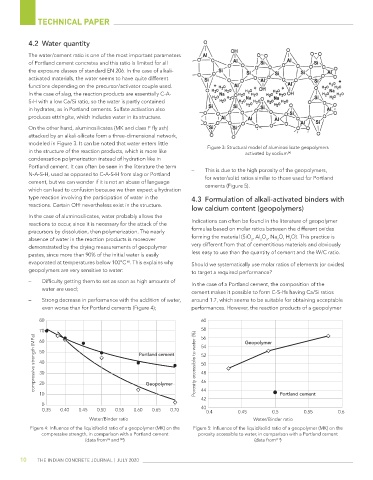
           modeled in Figure 3. It can be noted that water enters little
           in the structure of the reaction products, which is more like   Figure 3: structural model of aluminosilicate geopolymers
                                                                                    activated by sodium
                                                                                                   [4]
           condensation polymerization instead of hydration like in
           Portland cement. It can often be seen in the literature the term   –   This is due to the high porosity of the geopolymers,
           N-a-s-H, used as opposed to C-a-s-H from slag or Portland   for water/solid ratios similar to those used for Portland
           cement, but we can wonder if it is not an abuse of language
           which can lead to confusion because we then expect a hydration   cements (Figure 5).
           type reaction involving the participation of water in the   4.3  Formulation of alkali-activated binders with
           reactions. Certain OH  nevertheless exist in the structure.
                            -
                                                                  low calcium content (geopolymers)
           In the case of aluminosilicates, water probably allows the
           reactions to occur, since it is necessary for the attack of the   Indications can often be found in the literature of geopolymer
           precursors by dissolution, then polymerization. The nearly   formulas based on molar ratios between the different oxides
           absence of water in the reaction products is moreover   forming the material (siO , al O , Na O, H O). This practice is
                                                                                               2
                                                                                                   2
                                                                                           3
                                                                                      2
                                                                                         2
           demonstrated by the drying measurements of geopolymer   very different from that of cementitious materials and obviously
           pastes, since more than 90% of the initial water is easily   less easy to use than the quantity of cement and the W/C ratio.
           evaporated at temperatures below 100°C . This explains why   should we systematically use molar ratios of elements (or oxides)
                                             [6]
           geopolymers are very sensitive to water:               to target a required performance?
           –   Difficulty getting them to set as soon as high amounts of   In the case of a Portland cement, the composition of the
               water are used;
                                                                  cement makes it possible to form C-s-Hs having Ca/si ratios
           –   strong decrease in performance with the addition of water,   around 1.7, which seems to be suitable for obtaining acceptable
               even worse than for Portland cements (Figure 4);   performances. However, the reaction products of a geopolymer


           Figure 4: Influence of the liquid/solid ratio of a geopolymer (MK) on the   Figure 5: Influence of the liquid/solid ratio of a geopolymer (MK) on the
               compressive strength, in comparison with a Portland cement    porosity accessible to water, in comparison with a Portland cement
                              (data from  and )                                        (data from )
                                                                                               [11]
                                      [6]
                                          [10]
        10    The IndIan ConCreTe Journal | JulY 2020

