


Page 6 - OpenAccess-April-2021
P. 6
TECHNICAL PAPER


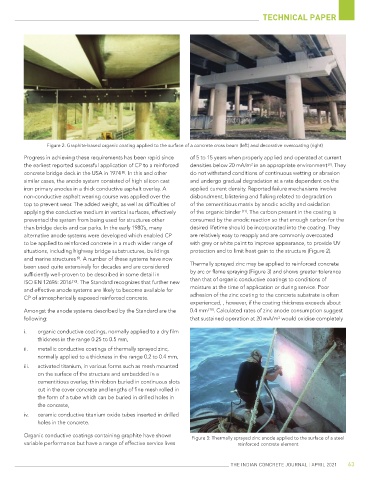
                 Figure 2: Graphite-based organic coating applied to the surface of a concrete cross beam (left) and decorative overcoating (right)

         Progress in achieving these requirements has been rapid since   of 5 to 15 years when properly applied and operated at current
         the earliest reported successful application of CP to a reinforced   densities below 20 mA/m  in an appropriate environment . They
                                                                                                              [9]
                                                                                    2
         concrete bridge deck in the USA in 1974 . In this and other   do not withstand conditions of continuous wetting or abrasion
                                          [8]
         similar cases, the anode system consisted of high silicon cast   and undergo gradual degradation at a rate dependent on the
         iron primary anodes in a thick conductive asphalt overlay. A   applied current density. Reported failure mechanisms involve
         non-conductive asphalt wearing course was applied over the   disbondment, blistering and flaking related to degradation
         top to prevent wear. The added weight, as well as difficulties of   of the cementitious matrix by anodic acidity and oxidation
         applying the conductive medium in vertical surfaces, effectively   of the organic binder  [11] . The carbon present in the coating is
         prevented the system from being used for structures other   consumed by the anodic reaction so that enough carbon for the
         than bridge decks and car parks. In the early 1980’s, many   desired lifetime should be incorporated into the coating. They
         alternative anode systems were developed which enabled CP   are relatively easy to reapply and are commonly overcoated
         to be applied to reinforced concrete in a much wider range of   with grey or white paint to improve appearance, to provide UV
         situations, including highway bridge substructures, buildings   protection and to limit heat gain to the structure (Figure 2).
                           [9]
         and marine structures . A number of these systems have now
         been used quite extensively for decades and are considered   Thermally sprayed zinc may be applied to reinforced concrete
         sufficiently well-proven to be described in some detail in   by arc or flame spraying (Figure 3) and shows greater tolerance
         ISO EN 12696: 2016  [10] . The Standard recognizes that further new   than that of organic conductive coatings to conditions of
         and effective anode systems are likely to become available for   moisture at the time of application or during service. Poor
         CP of atmospherically exposed reinforced concrete.     adhesion of the zinc coating to the concrete substrate is often
                                                                experienced, , however, if the coating thickness exceeds about
         Amongst the anode systems described by the Standard are the   0.4 mm  [10] . Calculated rates of zinc anode consumption suggest
         following:                                             that sustained operation at 20 mA/m  would oxidise completely
                                                                                             2
         i.   organic conductive coatings, normally applied to a dry film
             thickness in the range 0.25 to 0.5 mm,
         ii.   metallic conductive coatings of thermally sprayed zinc,
             normally applied to a thickness in the range 0.2 to 0.4 mm,
         iii.   activated titanium, in various forms such as mesh mounted
             on the surface of the structure and embedded in a
             cementitious overlay, thin ribbon buried in continuous slots
             cut in the cover concrete and lengths of fine mesh rolled in
             the form of a tube which can be buried in drilled holes in
             the concrete,
         iv.   ceramic conductive titanium oxide tubes inserted in drilled
             holes in the concrete.

         Organic conductive coatings containing graphite have shown
                                                                Figure 3: Thermally sprayed zinc anode applied to the surface of a steel
         variable performance but have a range of effective service lives       reinforced concrete element


                                                                             THE INDIAN CONCRETE JOURNAL | APRIL 2021  63

