


Page 9 - OpenAccess-April-2021
P. 9
TECHNICAL PAPER


             200                                                  100
                                                                 )
                                                                 2  10                    Range of values
           Depolarisation Potential (mV)  100                    Corrosion current density (mA/m  1  from Figure  11
             150


              50
                                              Size-1 Anode
                                              Size-2 Anode         0.1
               0                                                  0.01
               1.0                                        10.0        0    50      100     150    200    250     300
                                                                                             p
                             Current Density (mA/m ) 2                            Depolarisation otential (mV)
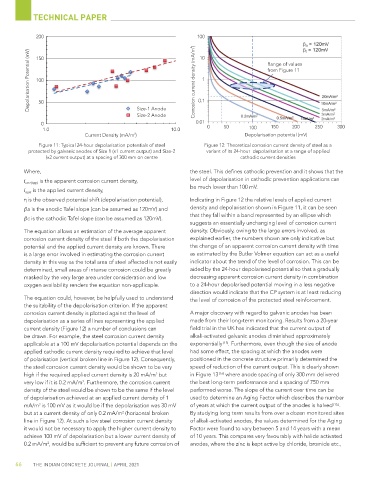
              Figure 11: Typical 24-hour depolarisation potentials of steel    Figure 12: Theoretical corrosion current density of steel as a
          protected by galvanic anodes of Size 1 (x1 current output) and Size-2    variant of its 24-hour  depolarisation at a range of applied
                (x2 current output) at a spacing of 300 mm on centre             cathodic current densities

         Where,                                                 the steel. This defines cathodic prevention and it shows that the
         i corr(app)  is the apparent corrosion current density,   level of depolarisation in cathodic prevention applications can
                                                                be much lower than 100 mV.
         i appl  is the applied current density,
         η is the observed potential shift (depolarisation potential),   Indicating in Figure 12 the relative levels of applied current
           a is the anodic Tafel slope (can be assumed as 120mV) and   density and depolarisation shown in Figure 11, it can be seen
                                                                that they fall within a band represented by an ellipse which
           c is the cathodic Tafel slope (can be assumed as 120mV).
                                                                suggests an essentially unchanging level of corrosion current
         The equation allows an estimation of the average apparent   density. Obviously, owing to the large errors involved, as
         corrosion current density of the steel if both the depolarisation   explained earlier, the numbers shown are only indicative but
         potential and the applied current density are known. There   the change of an apparent corrosion current density with time
         is a large error involved in estimating the corrosion current   as estimated by the Butler Volmer equation can act as a useful
         density in this way as the total area of steel affected is not easily   indicator about the trend of the level of corrosion. This can be
         determined, small areas of intense corrosion could be greatly   aided by the 24-hour depolarised potential so that a gradually
         masked by the very large area under consideration and low   decreasing apparent corrosion current density in combination
         oxygen availability renders the equation non-applicaple.  to a 24-hour depolarised potential moving in a less negative
                                                                direction would indicate that the CP system is at least reducing
         The equation could, however, be helpfully used to understand   the level of corrosion of the protected steel reinforcement.
         the suitability of the depolarisation criterion. If the apparent
         corrosion current density is plotted against the level of   A major discovery with regard to galvanic anodes has been
         depolarisation as a series of lines representing the applied   made from their long-term monitoring. Results from a 20-year
         current density (Figure 12) a number of conclusions can   field trial in the UK has indicated that the current output of
         be drawn. For example, the steel corrosion current density   alkali-activated galvanic anodes diminished approximately
         applicable at a 100 mV depolarisation potential depends on the   exponentially  [15] . Furthermore, even though the size of anode
         applied cathodic current density required to achieve that level   had some effect, the spacing at which the anodes were
         of polarisation (vertical broken line in Figure 12). Consequently,   positioned in the concrete structure primarily determined the
         the steel corrosion current density would be shown to be very   speed of reduction of the current output. This is clearly shown
         high if the required applied current density is 20 mA/m  but   in Figure 13  [16]  where anode spacing of only 300 mm delivered
                                                     2
         very low if it is 0.2 mA/m . Furthermore, the corrosion current   the best long-term performance and a spacing of 750 mm
                            2
         density of the steel would be shown to be the same if the level   performed worse. The slope of the current over time can be
         of depolarisation achieved at an applied current density of 1   used to determine an Aging Factor which describes the number
              2
         mA/m  is 100 mV as it would be if the depolarisation was 30 mV   of years at which the current output of the anodes is halved  [15,] .
         but at a current density of only 0.2 mA/m  (horizontal broken   By studying long term results from over a dozen monitored sites
                                         2
         line in Figure 12). At such a low steel corrosion current density   of alkali-activated anodes, the values determined for the Aging
         it would not be necessary to apply the higher current density to   Factor were found to vary between 5 and 14 years with a mean
         achieve 100 mV of depolarisation but a lower current density of   of 10 years. This compares very favourably with halide activated
         0.2 mA/m , would be sufficient to prevent any future corrosion of   anodes, where the zinc is kept active by chloride, bromide etc.,
                 2

      66    THE INDIAN CONCRETE JOURNAL | APRIL 2021

