


Page 4 - Open Access December - 2025
P. 4
POINT OF VIEW


           choices firstly by setting mandatory environmental criteria,   remains limited due to financial, regulatory, and awareness
                                                                           [26]
           such as using certain materials (e.g., recycled steel, low-VOC   constraints  . Anchoring Green Public Procurement within
           paints) and excluding harmful material or substances, and also   this policy landscape provides a strategic lever for promoting
           to drive innovation in eco-materials. Secondly, GPP encourages   reusable and recycled materials in India, reinforcing the GPP
           selection of materials based on life cycle assessments (LCA), and   approach discussed above.
           only based on initial costs. Third, GPP encourages transparency
           in the material selection in the upfront by demanding   8.  A CONCEPTUAL FRAMEWORK FOR
           environmental product declarations (EPDs) in the products and   MATERIAL SELECTION
           material passports (MP), making it easier to compare materials’
           environmental impact. Material passports are digital records   In response to these regulatory and policy contexts, the
           that provide detailed information about a material or product.   development of a conceptual framework that helps selecting
           They typically include product data, such as manufacturer,   reusable materials becomes crucial. This framework integrates
                                                         [24]
           origin, product codes, lifespan, and material composition  .   the principles of circular economy with practical decision-
           In addition, they capture embedded environmental impacts   making tools, providing a structured approach to assess and
           (e.g., whole life carbon) and circularity attributes, indicating   select reusable materials for construction. Anchored in both
           whether materials contain recycled content and their potential   international best practices, such as GPP, and emerging Indian
           for reuse or recycling at end of life. GPP also promotes reusing   policies, it guides stakeholders (e.g., architects, engineers,
           certain material so that they are re-entered to the production   policy-makers) in identifying which construction material(s) can
           loop rather than ending in landfills. These policy initiatives also   be recycled in their raw form, and how this knowledge supports
           provide a space for suppliers to develop and certify sustainable   circular economy principles.
           or modular materials.
                                                                  To begin with, the framework must be anchored in the
                                                                                                      [8]
           7.  CIRCULAR CONSTRUCTION POLICIES                     three core principles of the circular economy,   :eliminating
                                                                  waste and pollution, circulating products and materials, and
           AND PRACTICES IN INDIA
                                                                  regenerating natural systems alongside the widely used
           Building on the GPP framework, the Indian construction sector   cradle-to-cradle material designing school of thought. In the
           has begun aligning circular economy principles with national   context of construction, effective material selection during the
           policies. The Construction and Demolition Waste Management   early project phases (particularly RIBA Stages 1 to 3) requires
           Rules (2016) and subsequent amendments mandate         a clear understanding of the input materials and their long-
                                                [25]
           segregation, reuse, and recycling of C&D waste . Agencies   term performance within a circular system. It is thus essential
           such as CPWD and IRC have implemented recycled aggregates   to define robust material evaluation criteria, drawing from
           in infrastructure projects, demonstrating practical applications   established literature, in order to assess a material’s suitability
           of circular materials. The adoption of EPDs and MPs is still   for circular use. Using the criteria drawing from previous similar
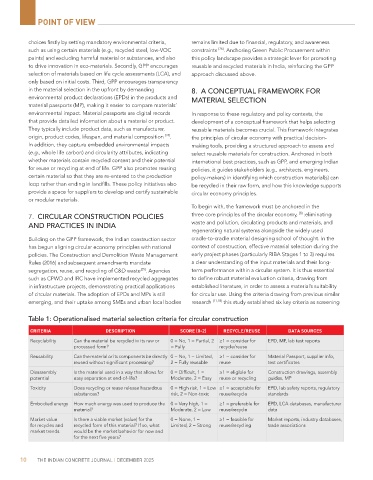
           emerging, and their uptake among SMEs and urban local bodies   research  [11,18]  this study established six key criteria as screening


           Table 1: Operationalised material selection criteria for circular construction
           CRITERIA                  DESCRIPTION              SCORE (0-2)   RECYCLE/REUSE         DATA SOURCES
           Recyclability  Can the material be recycled in its raw or   0 = No, 1 = Partial, 2  ≥1 = consider for   EPD, MP, lab test reports
                          processed form?                  = Fully         recycle/reuse
           Reusability    Can the material or its components be directly  0 = No, 1 = Limited,   ≥1 = consider for   Material Passport, supplier info,
                          reused without significant processing?  2 = Fully reusable  reuse  test certificates
           Disassembly    Is the material used in a way that allows for   0 = Difficult, 1 =   ≥1 = eligible for   Construction drawings, assembly
           potential      easy separation at end-of-life?  Moderate, 2 = Easy  reuse or recycling  guides, MP
           Toxicity       Does recycling or reuse release hazardous   0 = High risk, 1 = Low  ≥1 = acceptable for   EPD, lab safety reports, regulatory
                          substances?                      risk, 2 = Non-toxic  reuse/recycle  standards
           Embodied energy  How much energy was used to produce the  0 = Very high, 1 =   ≥1 = preferable for   EPD, LCA databases, manufacturer
                          material?                        Moderate, 2 = Low  reuse/recycle  data
           Market value   Is there a viable market (value) for the   0 = None, 1 =   ≥1 = feasible for   Market reports, industry databases,
           for recycles and   recycled form of this material? If so, what   Limited, 2 = Strong  reuse/recycling  trade associations
           market trends  would be the market behavior for now and
                          for the next five years?


        10    THE INDIAN CONCRETE JOURNAL | DECEMBER 2025

