


Page 6 - Open Access December - 2025
P. 6
POINT OF VIEW


           recycling in terms of embodied carbon, additional impacts   9.3 Reused steel + low-carbon binders
           from recovery logistics can occasionally offset these benefits,
           illustrating that context-specific assessment is essential.  CirCrete, as demonstrated by Nwonu et al. (2025)  [29] , shows
                                                                  that integrating reused steel reinforcement and low-carbon
           On the other hand, in a complementary study, Nwonu et al.   cementitious binders into concrete refurbishment projects
           (2025)  [29]  proposed CirCrete, a multi-criteria decision support   can substantially reduce embodied carbon. Within the scoring
           framework for end-of-life management of concrete structures.   framework, such strategies improve Embodied Energy and
           The framework integrates refurbishment, remanufacture, and   Toxicity scores, meaning that components previously destined
           recycling scenarios, and evaluates them against environmental,   for recycling could meet thresholds for reuse if other criteria,
           economic, and resource efficiency indicators. Case applications   such as disassembly and market value, are also favourable.
           demonstrated that refurbishment could deliver embodied
           carbon savings exceeding 60 % alongside significant cost   9.4  Quality protocols for recycled aggregates
           reductions compared to new construction. By providing a
                                                                  The case studies underscore the importance of robust quality
           structured methodology for assessing reuse and recycling
                                                                  assessment for secondary materials. Both the lightweight infill
           pathways, CirCrete offers practical insights into how concrete
           the most widely used construction material globally, including in   walls and CirCrete frameworks highlight that systematic testing
                                                                  and certification- such as grading, contamination checks, or
           India can be managed more sustainably at the end of its service   adherence to standards like EN 12620 allow practitioners to
           life. Comparative results from CirCrete further show that reuse
                                                                  confidently reuse recycled aggregates. In the scoring system,
           is most advantageous when transport distances and recovery
                                                                  this raises reusability and market value scores, increasing the
           efforts are low, whereas recycling or remanufacture may be   likelihood that materials are retained in higher-value circular
           preferable if logistics or processing requirements are high.  pathways.

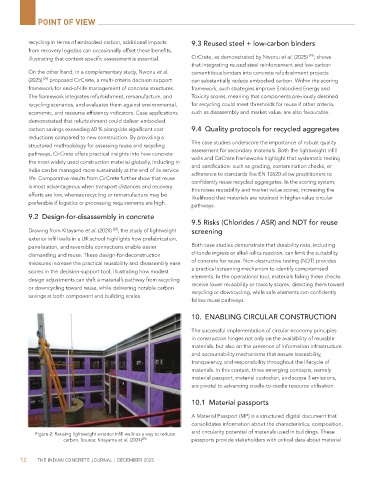
           9.2  Design-for-disassembly in concrete
                                                                  9.5 Risks (Chlorides / ASR) and NDT for reuse
           Drawing from Kitayama et al. (2024)  [28] , the study of lightweight   screening
           exterior infill walls in a UK school highlights how prefabrication,
           panelisation, and reversible connections enable easier   Both case studies demonstrate that durability risks, including
           dismantling and reuse. These design-for-deconstruction   chloride ingress or alkali-silica reaction, can limit the suitability
           measures increase the practical reusability and disassembly ease   of concrete for reuse. Non-destructive testing (NDT) provides
           scores in the decision-support tool, illustrating how modest   a practical screening mechanism to identify compromised
                                                                  elements. In the operational tool, materials failing these checks
           design adjustments can shift a material’s pathway from recycling
                                                                  receive lower reusability or toxicity scores, directing them toward
           or downcycling toward reuse, while delivering notable carbon
           savings at both component and building scales.         recycling or downcycling, while safe elements can confidently
                                                                  follow reuse pathways.

                                                                  10.  ENABLING CIRCULAR CONSTRUCTION

                                                                  The successful implementation of circular economy principles
                                                                  in construction hinges not only on the availability of reusable
                                                                  materials, but also on the presence of information infrastructure
                                                                  and accountability mechanisms that ensure traceability,
                                                                  transparency, and responsibility throughout the lifecycle of
                                                                  materials. In this context, three emerging concepts, namely
                                                                  material passport, material custodian, and scope 3 emissions,
                                                                  are pivotal to advancing cradle-to-cradle resource utilisation.


                                                                  10.1  Material passports

                                                                  A Material Passport (MP) is a structured digital document that
                                                                  consolidates information about the characteristics, composition,
             Figure 2: Reusing lightweight exterior infill walls as a way to reduce   and circularity potential of materials used in buildings. These
                      carbon. Source: Kitayama et al. (2024) [28]  passports provide stakeholders with critical data about material


        12    THE INDIAN CONCRETE JOURNAL | DECEMBER 2025

