


Page 5 - Open Access December - 2025
P. 5
POINT OF VIEW
thresholds that each material must meet to be considered By applying the six screening criteria outlined in Table 1, users
suitable for circular construction applications, as listed in Table 1. can systematically assess each material’s circular potential
during the early design stages. Based on the evaluation
The material selection criteria outlined in Table 1 have been outcomes, materials are then routed through a decision point,
operationalised into a decision-support tool by assigning scores leading to one of four pathways: reuse, recycle, downcycle, or
from 0-2 for each criterion, reflecting the material’s suitability landfill. This scoring-based methodology translates abstract
for circular reuse. A cumulative scoring system determines the circular economy concepts into actionable guidance, allowing
recommended pathway: materials with a total score of 10 or practitioners to make informed, replicable decisions on material
above, and a Reusability score of at least 1, are considered selection, while aligning with circular economy goals by enabling
suitable for direct reuse; scores of 7-9, or materials with high a consistent and replicable method for integrating circularity
recyclability but low reusability, are routed for recycling; and into construction practice. This framework also reinforces
materials scoring below 7 are directed toward downcycling or the principle of material custodianship , by encouraging
[27]
disposal. This approach allows practitioners to systematically stakeholders to take responsibility for materials throughout their
evaluate construction materials using objective metrics linked entire lifecycle, from selection to use and then to end-of-life
to data sources such as environmental product declarations, recovery, rather than viewing ownership as ending at the point
material passports, and test certificates. A worked example of sale.
illustrates the framework’s application: steel sections achieve the
reuse threshold, precast concrete is recommended for recycling, 9. CONCRETE-SPECIFIC CIRCULAR
and cast-in-place concrete is designated for downcycling or STRATEGIES
landfill, demonstrating the framework’s ability to translate
abstract circular economy principles into actionable material 9.1 Illustrative examples
selection.
Two examples are used here to illustrate the principles and
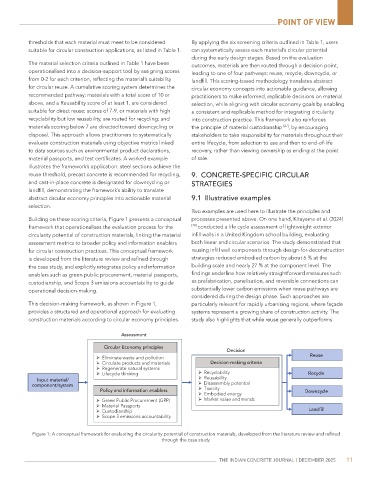
Building on these scoring criteria, Figure 1 presents a conceptual processes presented above. On one hand, Kitayama et al. (2024)
framework that operationalises the evaluation process for the [28] conducted a life cycle assessment of lightweight exterior
circularity potential of construction materials, linking the material infill walls in a United Kingdom school building, evaluating
assessment metrics to broader policy and information enablers both linear and circular scenarios. The study demonstrated that
for circular construction practices. This conceptual framework reusing infill wall components through design-for-deconstruction
is developed from the literature review and refined through strategies reduced embodied carbon by about 6 % at the
the case study, and explicitly integrates policy and information building scale and nearly 27 % at the component level. The
enablers such as green public procurement, material passports, findings underline how relatively straightforward measures such
custodianship, and Scope 3 emissions accountability to guide as prefabrication, panelisation, and reversible connections can
operational decision-making. substantially lower carbon emissions when reuse pathways are
considered during the design phase. Such approaches are
This decision-making framework, as shown in Figure 1, particularly relevant for rapidly urbanising regions, where façade
provides a structured and operational approach for evaluating systems represent a growing share of construction activity. The
construction materials according to circular economy principles. study also highlights that while reuse generally outperforms
Assessment
Circular Economy principles
Decision
Eliminate waste and pollution Reuse
Circulate products and materials Decision-making criteria
Regenerate natural systems
Lifecycle thinking Recyclability Recycle
Reusability
Input material/
component/system Disassembly potential
Policy and information enablers Toxicity Downcycle
Embodied energy
Green Public Procurement (GPP) Market value and trends
Material Passports
Custodianship Landfill
Scope 3 emissions accountability
Figure 1: A conceptual framework for evaluating the circularity potential of construction materials, developed from the literature review and refined
through the case study.
THE INDIAN CONCRETE JOURNAL | DECEMBER 2025 11

