


Page 4 - ICJ Jan 2026
P. 4
TECHNICAL PAPER


           100 YEARS OF CONCRETE


           MATERIALS SCIENCE                                                                BISHWAJIT BHATTACHARJEE*


           Abstract
           Concrete materials science originated with Abrams’ pioneering
           work and its evolution toward modern concrete composite is
           briefly discussed at the outset. Some research work, carried
           out at Indian Institute of Technology (IIT) Delhi, are presented.
           Key topics include a re-examination of Abrams’ Law, thermal
           conductivity of concrete, durability, and service life of concrete
           structural elements and sustainability related research. Lastly,
           the perceived knowledge gaps and way forward are highlighted
           elaborating opportunities for contemporary and near-future
           research.


           1.  INTRODUCTION                                                        (a) Gateway of India site
           Concrete, in a very general sense, has been used by human
                              [1]
           civilizations for millennia ; but the material science of concrete
           is barely more than 100 years old, initiating with Duff Abrams
           postulating the water-cement-ratio law in 1919 [2,3] . Notably,
           Abrams could also obtain a compressive strength as high as
                                                          [4]
           276 MPa for paste at a w/c of 0.08 with pressure application .
           Abrams also introduced the concepts of fineness modulus
           of aggregates, slump, and he invented the slump cone. In
           this sense, his work marks the true starting point of concrete
           science, and Abrams may be regarded as the father of concrete
           science. Interestingly, the Indian Concrete Journal (ICJ) started
           only a few years later in 1926 and is now continuing in its 100 th
           year. Subsequent pioneers, notably T.C. Powers, continued the

                                           [5]
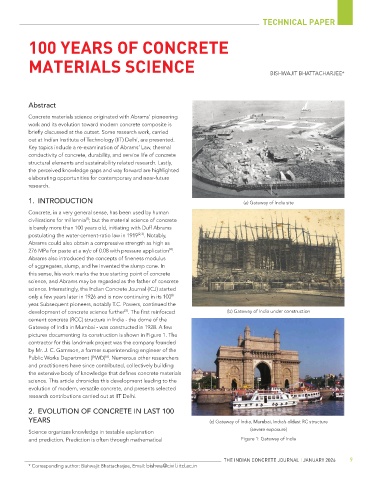
           development of concrete science further . The first reinforced     (b) Gateway of India under construction
           cement concrete (RCC) structure in India - the dome of the
           Gateway of India in Mumbai - was constructed in 1928. A few
           pictures documenting its construction is shown in Figure 1. The
           contractor for this landmark project was the company founded
           by Mr. J. C. Gammon, a former superintending engineer of the
                                     [6]
           Public Works Department (PWD) . Numerous other researchers
           and practitioners have since contributed, collectively building
           the extensive body of knowledge that defines concrete materials
           science. This article chronicles this development leading to the
           evolution of modern, versatile concrete, and presents selected
           research contributions carried out at IIT Delhi.

           2.  EVOLUTION OF CONCRETE IN LAST 100
           YEARS                                                        (c) Gateway of India, Mumbai, India’s oldest RC structure
           Science organizes knowledge in testable explanation                       (severe exposure)
           and prediction. Prediction is often through mathematical               Figure 1: Gateway of India


                                                                            THE INDIAN CONCRETE JOURNAL | JANUARY 2026  9
           * Corresponding author: Bishwajit Bhattacharjee, Email: bishwa@civil.iitd.ac.in

