


Page 9 - ICJ Jan 2026
P. 9
TECHNICAL PAPER


              200.00                                                80.0
                                                                    70.0
            strength(MPa)  150.00                                   60.0

                                                                    50.0
              100.00
                                                                    40.0
            Compressive  50.00                                     Compressive strength (MPa)  30.0
                                                                    20.0

               0.00                                                 10.0
                  0.25             0.35            0.45              0.0 0.2          0.3           0.4            0.5
                                     W/C ratio                                             W/C ratio
                3day         7days        28 days       56 days        3day         7days        28 days       56 days
                90 days      150days      180days                      90 days      150days      180days
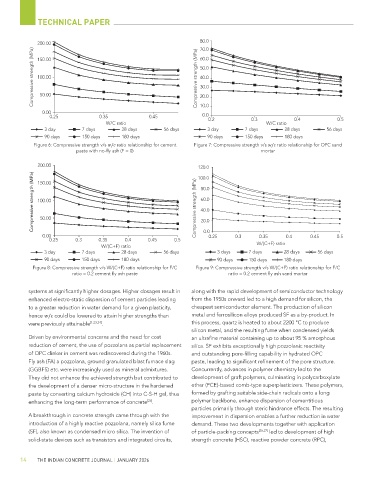
            Figure 6: Compressive strength v/s w/c ratio relationship for cement   Figure 7: Compressive strength v/s w/c ratio relationship for OPC sand
                           paste with no-fly ash (F = 0)                                 mortar

              200.00                                                120.0
            Compressive strength (MPa)  100.00                     Compressive strength (MPa)  80.0
                                                                    100.0
              150.00

                                                                     60.0

                                                                     40.0
               50.00

                                                                      0.0
               0.00                                                  20.0 0.25  0.3     0.35     0.4      0.45     0.5
                  0.25     0.3    0.35     0.4     0.45     0.5
                                   W/(C+F)ratio                                         W/(C+F) ratio
                3day         7days        28 days       56 days           3 days     7 days      28 days    56 days
                90 days      150days      180days                         90 days    150 days    180 days
            Figure 8: Compressive strength v/s W/(C+F) ratio relationship for F/C   Figure 9: Compressive strength v/s W/(C+F) ratio relationship for F/C
                         ratio = 0.2 cement fly ash paste                     ratio = 0.2 cement fly ash sand mortar


           systems at significantly higher dosages. Higher dosages result in   along with the rapid development of semiconductor technology
           enhanced electro-static dispersion of cement particles leading   from the 1950s onward led to a high demand for silicon, the
           to a greater reduction in water demand for a given plasticity,   cheapest semiconductor element. The production of silicon
           hence w/c could be lowered to attain higher strengths than   metal and ferrosilicon alloys produced SF as a by-product. In
           were previously attainable [1,23,24] .                 this process, quartz is heated to about 2200 °C to produce
                                                                  silicon metal, and the resulting fume when condensed yields
           Driven by environmental concerns and the need for cost   an ultrafine material containing up to about 95 % amorphous
           reduction of cement, the use of pozzolans as partial replacement   silica. SF exhibits exceptionally high pozzolanic reactivity
           of OPC clinker in cement was rediscovered during the 1960s.   and outstanding pore-filling capability in hydrated OPC
           Fly ash (FA) a pozzolana, ground granulated blast furnace slag   paste, leading to significant refinement of the pore structure.
           (GGBFS) etc. were increasingly used as mineral admixtures.   Concurrently, advances in polymer chemistry led to the
           They did not enhance the achieved strength but contributed to   development of graft polymers, culminating in polycarboxylate
           the development of a denser micro-structure in the hardened   ether (PCE)-based comb-type superplasticizers. These polymers,
           paste by converting calcium hydroxide (CH) into C-S-H gel, thus   formed by grafting suitable side-chain radicals onto a long
           enhancing the long-term performance of concrete .      polymer backbone, enhance dispersion of cementitious
                                                   [25]
                                                                  particles primarily through steric hindrance effects. The resulting
           A breakthrough in concrete strength came through with the   improvement in dispersion enables a further reduction in water
           introduction of a highly reactive pozzolana, namely silica fume   demand. These two developments together with application
           (SF), also known as condensed micro silica. The invention of   of particle-packing concepts [26,27]  led to development of high
           solid-state devices such as transistors and integrated circuits,   strength concrete (HSC), reactive powder concrete (RPC),


        14    THE INDIAN CONCRETE JOURNAL | JANUARY 2026

