


Page 11 - ICJ Jan 2026
P. 11
TECHNICAL PAPER


             3.5                                                    4.5
                                                                     4
              3
            Thermal conductivity (W/m.K)  1.5                      Thermal conductivity (W/m.K)  2.5 3 2
                                                                    3.5
             2.5
              2


                                                                    1.5
              1
             0.5

              0                                                     0.5 1 0
                0       20       40       60       80      100         0       20       40       60       80      100
                                Porosity (%)                                           Porosity (%)
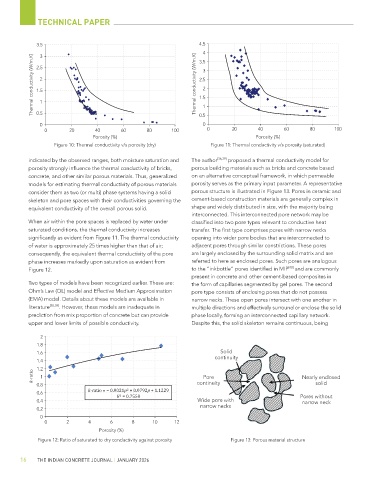
                   Figure 10: Thermal conductivity v/s porosity (dry)   Figure 11: Thermal conductivity v/s porosity (saturated)

           indicated by the observed ranges, both moisture saturation and   The author [36,39]  proposed a thermal conductivity model for
           porosity strongly influence the thermal conductivity of bricks,   porous building materials such as bricks and concrete based
           concrete, and other similar porous materials. Thus, generalized   on an alternative conceptual framework, in which permeable
           models for estimating thermal conductivity of porous materials   porosity serves as the primary input parameter. A representative
           consider them as two (or multi) phase systems having a solid   porous structure is illustrated in Figure 13. Pores in ceramic and
           skeleton and pore spaces with their conductivities governing the   cement-based construction materials are generally complex in
           equivalent conductivity of the overall porous solid.   shape and widely distributed in size, with the majority being
                                                                  interconnected. This interconnected pore network may be
           When air within the pore spaces is replaced by water under   classified into two pore types relevant to conductive heat
           saturated conditions, the thermal conductivity increases   transfer. The first type comprises pores with narrow necks
           significantly as evident from Figure 11. The thermal conductivity   opening into wider pore bodies that are interconnected to
           of water is approximately 25 times higher than that of air;   adjacent pores through similar constrictions. These pores
           consequently, the equivalent thermal conductivity of the pore   are largely enclosed by the surrounding solid matrix and are
           phase increases markedly upon saturation as evident from   referred to here as enclosed pores. Such pores are analogous
                                                                                                  [40]
           Figure 12.                                             to the “inkbottle” pores identified in MIP  and are commonly
                                                                  present in concrete and other cement-based composites in
           Two types of models have been recognized earlier. These are:   the form of capillaries segmented by gel pores. The second
           Ohm’s Law (OL) model and Effective Medium Approximation   pore type consists of enclosing pores that do not possess
           (EMA) model. Details about these models are available in   narrow necks. These open pores intersect with one another in
           literature [38,39] . However, these models are inadequate in   multiple directions and effectively surround or enclose the solid
           prediction from mix proportion of concrete but can provide   phase locally, forming an interconnected capillary network.
           upper and lower limits of possible conductivity.       Despite this, the solid skeleton remains continuous, being

               2
             1.8
             1.6                                                           Solid
                                                                         continuity
             1.4
             1.2
            k-ratio  1                                                Pore                             Nearly enclosed
             0.8                                                   continuity                              solid
                               k-ratio = − 0.0021p  + 0.0792p + 1.1229
             0.6
                                        R  = 0.7558                                                   Pores without
             0.4                                                    Wide pore with                     narrow neck
                                                                     narrow necks
             0.2
               0
                0      2       4      6       8     10      12
                                  Porosity (%)
              Figure 12: Ratio of saturated to dry conductivity against porosity  Figure 13: Porous material structure


        16    THE INDIAN CONCRETE JOURNAL | JANUARY 2026

