


Page 16 - ICJ Jan 2026
P. 16
TECHNICAL PAPER


                                2
           C 1  (0.0484) = 1.32 × 0.0484 – 0.12 × 0.0484 + 0.10 = 0.1025  Starting by assuming the value of k s  = 8.7, the values λ 1d , λ 2d ,
                                                                  λ 1s , and λ 2s  are calculated. Consequently, calculated value is
                                 2
           D 1  (0.0484) = – 1.38 × 0.0484 + 0.78 × 0.0484 + 0.84 = 0.8745
                                                                  obtained as f = 0.995. The estimated values of k ed  and k es  are
                                  2
           C 2  (0.0484) = – 0.165 × 0.0484 + 0.479 × 0.0484 = 0.0228  8.58 and 8.64 W/m.K respectively. Thus, k s  = 8.7 and f = 0.995 are
                                                                  deemed appropriate.
           D 2  (0.0484) = e – 0.0484 = 2.7182 – 0.0484 = 2.6698
           Hence,    = C 1  (0.0484) k s  + D 1  (0.0484) = 0.1025 × 5 + 0.8745 =   Values of k s  and f calculated in similar manner as above for
           1.387; λ 1s  = 0.7210                                  various rocks are given in Table 3. The fraction of enclosed
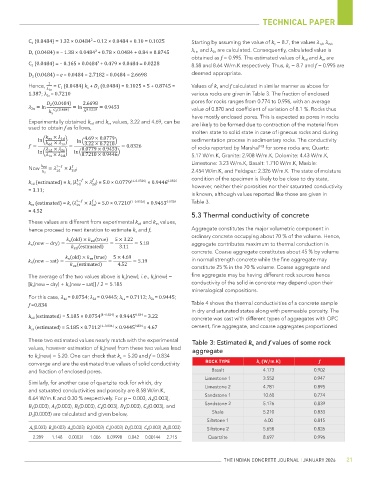
                                                                  pores for rocks ranges from 0.774 to 0.996, with an average
                                                                  value of 0.870 and coefficient of variation of 8.1 %. Rocks thus
                                                                  have mostly enclosed pores. This is expected as pores in rocks
           Experimentally obtained k ed  and k es  values, 3.22 and 4.69, can be   are likely to be formed due to contraction of the material from
           used to obtain f as follows,
                                                                  molten state to solid state in case of igneous rocks and during
                                                                  sedimentation process in sedimentary rocks. The conductivity
                                                                                        [43]
                                                                  of rocks reported by Marshal  for some rocks are; Quartz:
                                                                  5.17 W/m.K, Granite: 2.908 W/m.K, Dolomite: 4.43 W/m.K,
                                                                  Limestone: 3.23 W/m.K, Basalt: 1.710 W/m.K, Marble:
           Now
                                                                  2.454 W/m.K, and Feldspar: 2.326 W/m.K. The state of moisture
                                                                  condition of the specimen is likely to be close to dry state,
           k ed  (estimated) = k s  (  ) = 5.0 × 0.0779 (1–0.8326)  × 0.9446 0.8326
                                                                  however, neither their porosities nor their saturated conductivity

           = 3.11;
                                                                  is known, although values reported like those are given in
           k es  (estimated) = k s  (  ) = 5.0 × 0.7210 (1–0.8326)  × 0.9453 0.8326   Table 3.
           = 4.52
                                                                  5.3 Thermal conductivity of concrete
           These values are different from experimental k ed  and k es  values,
           hence proceed to next iteration to estimate k s  and f,  Aggregate constitutes the major volumetric component in
                                                                  ordinary concrete occupying about 70 % of the volume. Hence,
                                                                  aggregate contributes maximum to thermal conduction in
                                                                  concrete. Coarse aggregate constitutes about 45 % by volume
                                                                  in normal strength concrete while the fine aggregate may
                                                                  constitute 25 % in the 70 % volume. Coarse aggregate and
           The average of the two values above is k s (new); i.e., k s (new) =   fine aggregate may be having different rock sources hence
           [k s (new – dry) + k s (new – sat)] / 2 = 5.185        conductivity of the solid in concrete may depend upon their

                                                                  mineralogical compositions.
           For this case, λ 1d  = 0.0754; λ 2d  = 0.9445; λ 1s  = 0.7112; λ 2s  = 0.9445;
           f =0.834                                               Table 4 shows the thermal conductivities of a concrete sample
                                                                  in dry and saturated states along with permeable porosity. The
                                   (1–0.834)   0.834
           k ed  (estimated) = 5.185 × 0.0754   × 0.9445  = 3.22  concrete was cast with different types of aggregates with OPC
           k es  (estimated) = 5.185 × 0.7112 (1–0.834)  × 0.9445 0.834  = 4.67  cement, fine aggregate, and coarse aggregates proportioned
           These two estimated values nearly match with the experimental   Table 3: Estimated k  and f values of some rock
           values, however estimation of k s (new) from these two values lead   aggregate  s
           to k s (new) = 5.20. One can check that k s  = 5.20 and f = 0.834
           converge and are the estimated true values of solid conductivity   ROCK TYPE  k s  (W/m.K)        f
           and fraction of enclosed pores.                              Basalt            4.173            0.902
                                                                      Limestone 1         3.552            0.947
           Similarly, for another case of quartzite rock for which, dry
           and saturated conductivities and porosity are 8.58 W/m.K,   Limestone 2        4.781            0.895
                                                                      Sandstone 1         10.60            0.774
           8.64 W/m.K and 0.30 % respectively. For p = 0.003, A 1 (0.003),
           B 1 (0.003), A 2 (0.003), B 2 (0.003), C 1 (0.003), D 1 (0.003), C 2 (0.003), and   Sandstone 2  5.176  0.839
           D 2 (0.0003) are calculated and given below,                  Shale            5.210            0.833
                                                                       Siltstone 1        6.00             0.815
           A 1 (0.003) B 1 (0.003) A 2 (0.003) B 2 (0.003) C 1 (0.003) D 1 (0.003) C 2 (0.003) D 2 (0.003)  Siltstone 2  5.658  0.826

            2.289  1.148  0.00031  1.006  0.09998  0.842  0.00144  2.715  Quartzite       8.697            0.996


                                                                            THE INDIAN CONCRETE JOURNAL | JANUARY 2026  21

