


Page 20 - ICJ Jan 2026
P. 20
TECHNICAL PAPER


             7 6                                                    2.5 3

            Conductivity of solid W/m.K  5 4 3 2  k = 0.883V sand + 4.6859  Conductivity of solid W/m.K  1.5 2 1  k  = 0.6026 V − 2.6392 V + 3.4331  k = − 1.8603 V + 3.2161


                                           s
                                             R² = 0.2239
                                                                                 2
                                                                                         p
                                                                         s
                                                                                R² = 0.9893
                                                                                                           p

             0 1                                                    0.5 0                         s  R² = 0.9851
               0      0.2    0.4     0.6    0.8      1      1.2        0     0.2     0.4    0.6     0.8     1      1.2
                     Volumetric sand content in aggregate (fraction)             Volumetric paste content fraction
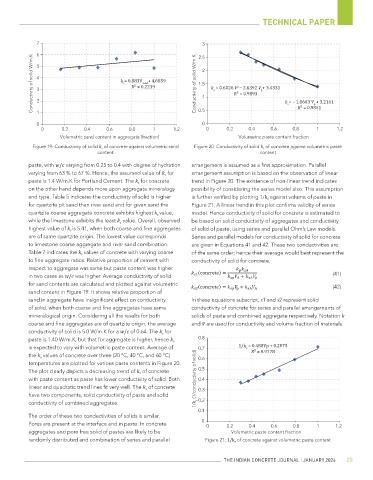
            Figure 19: Conductivity of solid k s  of concrete against volumetric sand   Figure 20: Conductivity of solid k s  of concrete against volumetric paste
                                  content                                                content
           paste, with w/c varying from 0.25 to 0.4 with degree of hydration   arrangement is assumed as a first approximation. Parallel
           varying from 63 % to 67 %. Hence, the assumed value of k s  for   arrangement assumption is based on the observation of linear
           paste is 1.4 W/m.K for Portland Cement. The k s  for concrete   trend in Figure 20. The existence of non-linear trend indicates
           on the other hand depends more upon aggregate mineralogy   possibility of considering the series model also. This assumption
           and type. Table 5 indicates the conductivity of solid is higher   is further verified by plotting 1/k s  against volume of paste in
           for quartzite pit sand than river sand and for given sand the   Figure 21. A linear trend in this plot confirms validity of series
           quartzite coarse aggregate concrete exhibits highest k s  value,   model. Hence conductivity of solid for concrete is estimated to
           while the limestone exhibits the least k s  value. Overall, observed   be based on solid conductivity of aggregates and conductivity
           highest value of k s  is 5.41, when both coarse and fine aggregates   of solid of paste, using series and parallel Ohm’s Law models.
           are of same quartzite origin. The lowest value corresponds   Series and parallel models for conductivity of solid for concrete
           to limestone coarse aggregate and river sand combination.   are given in Equations 41 and 42. These two conductivities are
           Table 7 indicates the k s  values of concrete with varying coarse   of the same order; hence their average would best represent the
           to fine aggregate ratios. Relative proportion of cement with   conductivity of solid for concrete.
           respect to aggregate was same but paste content was higher
           in two cases as w/c was higher. Average conductivity of solid                                         (41)
           for sand contents are calculated and plotted against volumetric                                       (42)
           sand content in Figure 19. It shows relative proportion of
           sand in aggregate have insignificant effect on conductivity   In these equations subscript, s1 and s2 represent solid
           of solid, when both coarse and fine aggregates have same   conductivity of concrete for series and parallel arrangements of
           mineralogical origin. Considering all the results for both   solids of paste and combined aggregate respectively. Notation k
           coarse and fine aggregates are of quartzite origin, the average   and V are used for conductivity and volume fraction of materials.
           conductivity of solid is 5.0 W/m.K for a w/c of 0.64. The k s  for
           paste is 1.40 W/m.K, but that for aggregate is higher, hence k s    0.8
           is expected to vary with volumetric paste content. Average of   0.7   1/k  = 0.488Vp + 0.2075
                                                                                    s
           the k s  values of concrete over three (20 °C, 40 °C, and 60 °C)   0.6     R² = 0.9778
           temperatures are plotted for various paste contents in Figure 20.
           The plot clearly depicts a decreasing trend of k s  of concrete   0.5
           with paste content as paste has lower conductivity of solid. Both   1/k s  (1/conductivity of solid)  0.4
           linear and quadratic trend lines fit very well. The k s  of concrete   0.3
           have two components, solid conductivity of paste and solid
           conductivity of combined aggregates.                     0.2
                                                                    0.1
           The order of these two conductivities of solids is similar.
           Pores are present at the interface and in paste. In concrete   0  0  0.2  0.4    0.6     0.8     1     1.2
           aggregates and pore free solid of pastes are likely to be           Volumetric paste content fraction
           randomly distributed and combination of series and parallel   Figure 21: 1/k s  of concrete against volumetric paste content


                                                                            THE INDIAN CONCRETE JOURNAL | JANUARY 2026  25

