


Page 15 - ICJ Jan 2026
P. 15
TECHNICAL PAPER


           The regression of λ 2s  with solid conductivity leads to following   water saturated effective conductivity k es , the k s  and f can be
           form of equation,                                      obtained through a trial-and-error procedure as described
                                                                  below and elaborated in the references [36,39] .
                                                          (34)
                                                                  5.2  Application of the model to rock for
           Further regression of C 2 (p), D 2 (p) and E 2 (p) result in following
           equations,                                             aggregate
                                                                  Thermal conductivity of some rocks used as aggregates are then
                                                          (36)
                                                                  obtained first. Measured thermal conductivity of some rocks are
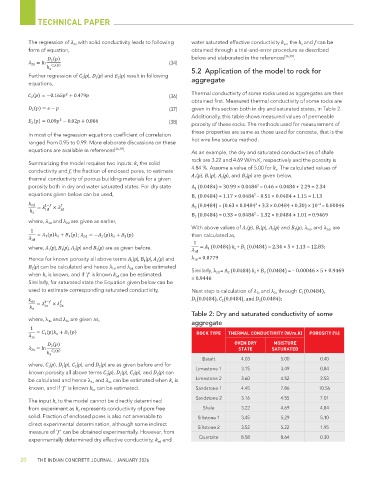
                                                          (37)    given in this section both in dry and saturated states, in Table 2.
                                                                  Additionally, this table shows measured values of permeable
                                                          (38)    porosity of these rocks. The methods used for measurement of
                                                                  these properties are same as those used for concrete, that is the
           In most of the regression equations coefficient of correlation
           ranged from 0.95 to 0.99. More elaborate discussions on these   hot wire line source method.
           equations are available in references [36,39] .        As an example, the dry and saturated conductivities of shale
                                                                  rock are 3.22 and 4.69 W/m.K, respectively and the porosity is
           Summarizing the model requires two inputs: k s  the solid
           conductivity and f, the fraction of enclosed pores, to estimate   4.84 %. Assume a value of 5.00 for k s . The calculated values of
           thermal conductivity of porous building materials for a given   A 1 (p), B 1 (p), A 2 (p), and B 2 (p) are given below.
           porosity both in dry and water saturated states. For dry state   A 1  (0.0484) = 30.99 × 0.0484 – 0.46 × 0.0484 + 2.29 = 2.34
                                                                                        2_
           equations given below can be used,
                                                                                       2
                                                                  B 1  (0.0484) = 1.17 × 0.0484 – 0.51 × 0.0484 + 1.15 = 1.13
                                                                                       2                    –3
                                                                  A 2  (0.0484) = (0.63 × 0.0484 + 3.3 × 0.0484 + 0.30) × 10 = 0.00046
                                                                                       2
                                                                  B 2  (0.0484) = 0.33 × 0.0484 – 1.32 × 0.0484 + 1.01 = 0.9469
           where, λ 1d  and λ 2d  are given as earlier,
                                                                  With above values of A 1 (p), B 1 (p), A 2 (p) and B 2 (p), λ 1d , and λ 2d , are
                            ;                                     then calculated as,
           where, A 1 (p), B 1 (p), A 2 (p) and B 2 (p) are as given before.   A 1  (0.0484) k s  + B 1  (0.0484) = 2.34 × 5 + 1.13 = 12.83;
           Hence for known porosity all above terms A 1 (p), B 1 (p), A 2 (p) and   λ 1d  = 0.0779
           B 2 (p) can be calculated and hence λ 1d  and λ 2d  can be estimated
                                                                  Similarly, λ 2d  = A 2  (0.0484) k s  + B 2  (0.0484) = – 0.00046 × 5 + 0.9469
           when k s  is known, and if ‘f’ is known k ed  can be estimated.
                                                                  = 0.9446
           Similarly, for saturated state the Equation given below can be
           used to estimate corresponding saturated conductivity,  Next step is calculation of λ 1s  and λ 2s  through C 1  (0.0484),
                                                                  D 1 (0.0484), C 2 (0.0484), and D 2 (0.0484);

                                                                  Table 2: Dry and saturated conductivity of some
           where, λ 1s  and λ 2s  are given as,
                                                                  aggregate
                                                                   ROCK TYPE  THERMAL CONDUCTIVITY (W/m.K)  POROSITY (%)
                                                                                OVEN DRY     MOISTURE
                                                                                 STATE       SATURATED
                                                                     Basalt       4.03          5.00         0.40
           where, C 1 (p), D 1 (p), C 2 (p), and D 2 (p) are as given before and for
           known porosity all above terms C 1 (p), D 1 (p), C 2 (p), and D 2 (p) can   Limestone 1  3.15  3.49  0.84
           be calculated and hence λ 1s  and λ 2s  can be estimated when k s  is   Limestone 2  3.60  4.52   2.53
           known, and if ‘f ’ is known k es  can be estimated.     Sandstone 1    4.45          7.86         10.56
                                                                   Sandstone 2    3.16          4.55         7.01
           The input k s  to the model cannot be directly determined
           from experiment as k s  represents conductivity of pore free   Shale   3.22          4.69         4.84
           solid. Fraction of enclosed pores is also not amenable to   Siltstone 1  3.45        5.29         5.10
           direct experimental determination, although some indirect   Siltstone 2  3.52        5.22         1.95
           measure of ‘f ’ can be obtained experimentally. However, from
           experimentally determined dry effective conductivity, k ed  and   Quartzite  8.58    8.64         0.30


        20    THE INDIAN CONCRETE JOURNAL | JANUARY 2026

