


Page 14 - ICJ Jan 2026
P. 14
TECHNICAL PAPER


                                                                                                                 (26)

                                                                  From Equations 24 and 25, A 1 (p)k p  = a 1  (p), k p  (air) = 0.0258, hence,
                                                                                             2
                                                                  a 1  (p) = k p  × A 1  (p) = 0.0258 × (30.99p  – 0.46p + 2.29) i.e., a 1  (p) =
                                                                  0.799p  – 0.012p+0.059. For p = 0, a 1  (0) = 0.059 is nearly equal to
                                                                       2
                                                                  zero; and p = 1, a 1  (1) = 0.846, which is close to 1.
                                                                  Thus, similarly as 1/λ 1d , 1/λ 1s  can be written as 1/λ 1s  = C 1  (p) k s  +
                                                                  D 1  (p) as 1/λ 1s  varies linearly when the pores are saturated with
                                                                  water, the conductivity of the pore is taken as water conductivity
                                                                  i.e., 0.6051 W/m.K. For cell with water-filled enclosing pore,
                                                                                                                 (27)


                                                                                                                 (28)
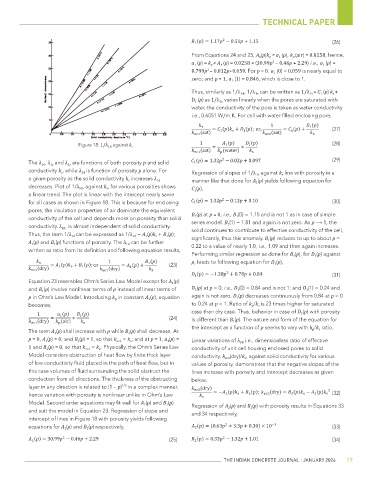
                           Figure 18: 1/λ 1d  against k s
                                                                                                                 (29)
           The λ 1d , λ 1s  and λ 2s  are functions of both porosity p and solid
           conductivity k s , while λ 2d  is function of porosity p alone. For   Regression of slopes of 1/λ 1s  against k s  line with porosity in a
           a given porosity as the solid conductivity k s  increases λ 1d    manner like that done for A 1 (p) yields following equation for
           decreases. Plot of 1/λ 1d , against k s , for various porosities shows   C 1 (p),
           a linear trend. The plot is linear with the intercept nearly same
           for all cases as shown in Figure 18. This is because for enclosing                                    (30)
           pores, the insulation properties of air dominate the equivalent
           conductivity of the cell and depends more on porosity than solid   B 1 (p) at p = 0, i.e., B 1 (0) = 1.15 and is not 1 as in case of simple
                                                                  series model. B 1 (1) = 1.81 and again is not zero. As p ⟶ 1, the
           conductivity. λ 2d , is almost independent of solid conductivity.
           Thus, the term 1/λ 1d  can be expressed as 1/λ 1d  = A 1 (p)k s  + B 1 (p);   solid continues to contribute to effective conductivity of the cell,
                                                                  significantly, thus this anomaly. B 1 (p) reduces to up to about p =
           A 1 (p) and B 1 (p) functions of porosity. The λ 1d  can be further   0.22 to a value of nearly 1.0, i.e., 1.09 and then again increases.
           written as ratio from its definition and following equation results,
                                                                  Performing similar regression as done for B 1 (p), for D 1 (p) against
                                                                  p, leads to following equation for D 1 (p),
                                 or                       (23)
                                                                                                                 (31)
           Equation 23 resembles Ohm’s Series Law Model except for A 1 (p)
           and B 1 (p) involve nonlinear terms of p instead of linear terms of   D 1 (p) at p = 0, i.e., D 1 (0) = 0.84 and is not 1; and D 1 (1) = 0.24 and
           p in Ohm’s Law Model. Introducing k p  in constant A 1 (p), equation   again is not zero. D 1 (p) decreases continuously from 0.84 at p = 0
           becomes,                                               to 0.24 at p = 1. Ratio of k p /k s  is 23 times higher for saturated
                                                                  case than dry case. Thus, behavior in case of D 1 (p) with porosity
                                                          (24)    is different than B 1 (p). The nature and form of the equation for
                                                                  the intercept as a function of p seems to vary with k p /k s  ratio.
           The term A 1 (p) shall increase with p while B 1 (p) shall decrease. At
           p = 0, A 1 (p) = 0; and B 1 (p) = 1, so that k ec1  = k s ; and at p = 1, a 1 (p) =   Linear variations of λ 2d  i.e., dimensionless ratio of effective
           1 and B 1 (p) = 0, so that k ec1  = k p . Physically, the Ohm’s Series Law   conductivity of unit cell housing enclosed pores to solid
           Model considers obstruction of heat flow by finite thick layer   conductivity, k ec2 (dry)/k s , against solid conductivity for various
           of low conductivity fluid placed in the path of heat flow, but in   values of porosity, demonstrate that the negative slopes of the
           this case volumes of fluid surrounding the solid obstruct the   lines increase with porosity and intercept decreases as given
           conduction from all directions. The thickness of the obstructing   below,
                                          1/3
           layer in any direction is related to (1 – p)  in a complex manner,
           hence variation with porosity is nonlinear unlike in Ohm’s Law                                        (32)
           Model. Second order equations may fit well for A 1 (p) and B 1 (p)   Regression of A 2 (p) and B 2 (p) with porosity results in Equations 33
           and suit the model in Equation 23. Regression of slope and   and 34 respectively,
           intercept of lines in Figure 18 with porosity yields following
           equations for A 1 (p) and B 1 (p) respectively,                                                       (33)

                                                          (25)                                                   (34)


                                                                            THE INDIAN CONCRETE JOURNAL | JANUARY 2026  19

