


Page 19 - ICJ Jan 2026
P. 19
TECHNICAL PAPER


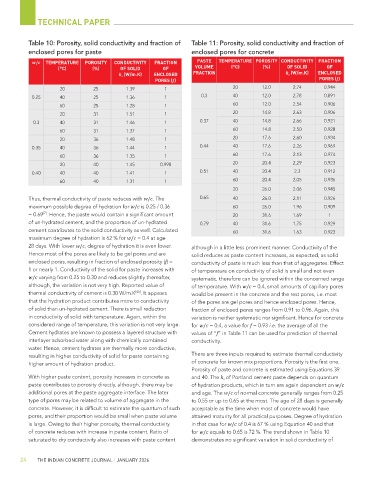
           Table 10: Porosity, solid conductivity and fraction of   Table 11: Porosity, solid conductivity and fraction of
           enclosed pores for paste                               enclosed pores for concrete
            w/c  TEMPERATURE   POROSITY    CONDUCTIVITY   FRACTION   PASTE   TEMPERATURE  POROSITY  CONDUCTIVITY   FRACTION
                     (°C)       (%)       OF SOLID      OF         VOLUME      (°C)       (%)     OF SOLID     OF
                                         k s  (W/m.K)  ENCLOSED   FRACTION                       k s  (W/m.K)  ENCLOSED
                                                     PORES (f)                                               PORES (f)
                     20          25         1.39        1                       20       12.0       2.74      0.944
            0.25     40          25         1.36        1            0.3        40       12.0       2.78      0.891
                     60          25         1.28        1                       60       12.0       2.54      0.906
                     20          31         1.51        1                       20       14.8       2.63      0.906
            0.3      40          31         1.46        1           0.37        40       14.8       2.66      0.921
                     60          31         1.37        1                       60       14.8       2.50      0.928
                     20          36         1.48        1                       20       17.6       2.60      0.934
            0.35     40          36         1.44        1           0.44        40       17.6       2.26      0.969
                     60          36         1.35        1                       60       17.6       2.13      0.974
                     20          40         1.45       0.998                    20       20.4       2.29      0.923
            0.40     40          40         1.41        1           0.51        40       20.4       2.3       0.912
                     60          40         1.31        1                       60       20.4       2.05      0.936
                                                                                20       26.0       2.06      0.945
           Thus, thermal conductivity of paste reduces with w/c. The   0.65     40       26.0       2.11      0.926
           maximum possible degree of hydration for w/c is 0.25 / 0.36          60       26.0       1.96      0.909
           = 0.69 . Hence, the paste would contain a significant amount         20       31.6       1.69        1
                [7]
           of un-hydrated cement, and the proportion of un-hydrated   0.79      40       31.6       1.75      0.929
           cement contributes to the solid conductivity as well. Calculated     60       31.6       1.63      0.923
           maximum degree of hydration is 62 % for w/c = 0.4 at age
           28 days. With lower w/c, degree of hydration h is even lower.   although in a little less prominent manner. Conductivity of the
           Hence most of the pores are likely to be gel pores and are   solid reduces as paste content increases, as expected, as solid
           enclosed pores, resulting in fraction of enclosed porosity (f) =   conductivity of paste is much less than that of aggregates. Effect
           1 or nearly 1. Conductivity of the solid for paste increases with   of temperature on conductivity of solid is small and not even
           w/c varying from 0.25 to 0.30 and reduces slightly thereafter,   systematic, therefore can be ignored within the concerned range
           although, the variation is not very high. Reported value of   of temperature. With w/c = 0.4, small amounts of capillary pores
           thermal conductivity of cement is 0.30 W/m.K . It appears   would be present in the concrete and the rest pores, i.e. most
                                               [45]
           that the hydration product contributes more to conductivity   of the pores are gel pores and hence enclosed pores. Hence,
           of solid than un-hydrated cement. There is small reduction   fraction of enclosed pores ranges from 0.91 to 0.96. Again, this
           in conductivity of solid with temperature. Again, within the   variation is neither systematic nor significant. Hence for concrete
           considered range of temperature, this variation is not very large.   for w/c = 0.4, a value for f = 0.93 i.e. the average of all the
           Cement hydrates are known to possess a layered structure with   values of “f” in Table 11 can be used for prediction of thermal
           interlayer adsorbed water along with chemically combined   conductivity.
           water. Hence, cement hydrates are thermally more conductive,
           resulting in higher conductivity of solid for paste containing   There are three inputs required to estimate thermal conductivity
           higher amount of hydration product.                    of concrete for known mix proportions. Porosity is the first one.
                                                                  Porosity of paste and concrete is estimated using Equations 39
           With higher paste content, porosity increases in concrete as   and 40. The k s  of Portland cement paste depends on quantum
           paste contributes to porosity directly, although, there may be   of hydration products, which in turn are again dependent on w/c
           additional pores at the paste aggregate interface. The later   and age. The w/c of normal concrete generally ranges from 0.25
           type of pores may be related to volume of aggregate in the   to 0.55 or up to 0.65 at the most. The age of 28 days is generally
           concrete. However, it is difficult to estimate the quantum of such   acceptable as the time when most of concrete would have
           pores, and their proportion would be small when paste volume   attained maturity for all practical purposes. Degree of hydration
           is large. Owing to their higher porosity, thermal conductivity   in that case for w/c of 0.4 is 67 % using Equation 40 and that
           of concrete reduces with increase in paste content. Ratio of   for w/c equals to 0.65 is 72 %. The trend shown in Table 10
           saturated to dry conductivity also increases with paste content   demonstrates no significant variation in solid conductivity of


        24    THE INDIAN CONCRETE JOURNAL | JANUARY 2026

