


Page 23 - ICJ Jan 2026
P. 23
TECHNICAL PAPER


             0.9                                                     1200
                                   f = 0.0088p                               = 16.97(100 − p)
             0.8                  R² = 0.9662                        1000    R² = 0.95
            Fraction of enclosed pores (f )  0.6                   Bulk density kg/m 3  800
             0.7


             0.5
                                                                      600
             0.4
             0.3
                                                                      400
             0.2
             0.1                                                      200
              0                                                        0
                0       20       40       60       80       100          0    10    20     30    40    50    60    70
                                  Porosity (%)                                       100 − porosity [100 − p(%)]
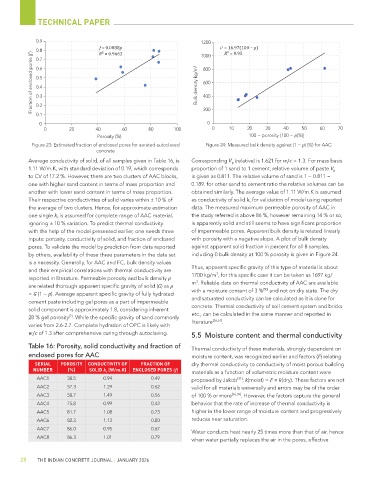
            Figure 23: Estimated fraction of enclosed pores for aerated autoclaved   Figure 24: Measured bulk density against (1 − p) (%) for AAC
                                  concrete
           Average conductivity of solid, of all samples given in Table 16, is   Corresponding V p  (relative) is 1.621 for w/c = 1.3. For mass basis
           1.11 W/m.K, with standard deviation of 0.19, which corresponds   proportion of 1 sand to 1 cement, relative volume of paste V p
           to CV of 17.2 %. However, there are two clusters of AAC blocks,   is given as 0.811. The relative volume of sand is 1 − 0.811 =
           one with higher sand content in terms of mass proportion and   0.189. for other sand to cement ratio the relative volumes can be
           another with lower sand content in terms of mass proportion.   obtained similarly. The average value of 1.11 W/m.K is assumed
           Their respective conductivities of solid varies within ± 10 % of   as conductivity of solid k s  for validation of model using reported
           the average of two clusters. Hence, for approximate estimation   data. The measured maximum permeable porosity of AAC in
           one single k s  is assumed for complete range of AAC material,   the study referred is above 86 %, however remaining 14 % or so,
           ignoring ± 10 % variation. To predict thermal conductivity   is apparently solid and still seems to have significant proportion
           with the help of the model presented earlier, one needs three   of impermeable pores. Apparent bulk density is related linearly
           inputs: porosity, conductivity of solid, and fraction of enclosed   with porosity with a negative slope. A plot of bulk density
           pores. To validate the model by prediction from data reported   against apparent solid fraction in percent for all 8 samples,
           by others, availability of these three parameters in the data set   including 0 bulk density at 100 % porosity is given in Figure 24.
           is a necessity. Generally, for AAC and FC, bulk density values
           and their empirical correlations with thermal conductivity are   Thus, apparent specific gravity of this type of material is about
                                                                          3
           reported in literature. Permeable porosity and bulk density ρ   1700 kg/m , for this specific case it can be taken as 1697 kg/
                                                                   3
           are related thorough apparent specific gravity of solid (G) as ρ   m . Reliable data on thermal conductivity of AAC are available
                                                                                          [50]
           = G (1 − p). Average apparent specific gravity of fully hydrated   with a moisture content of 3 %  and not on dry state. The dry
           cement paste including gel pores as a part of impermeable   and saturated conductivity can be calculated as it is done for
           solid component is approximately 1.8, considering inherent   concrete. Thermal conductivity of soil cement system and bricks
                        [7]
           28 % gel porosity . While the specific gravity of sand commonly   etc., can be calculated in the same manner and reported in
                                                                         [36,51]
           varies from 2.6-2.7. Complete hydration of OPC is likely with   literature  .
           w/c of 1.3 after comprehensive curing through autoclaving.
                                                                  5.5  Moisture content and thermal conductivity
           Table 16: Porosity, solid conductivity and fraction of   Thermal conductivity of these materials, strongly dependent on
           enclosed pores for AAC                                 moisture content, was recognized earlier and factors (F) relating
             SERIAL   POROSITY   CONDUCTIVITY OF   FRACTION OF    dry thermal conductivity to conductivity of moist porous building
            NUMBER      (%)    SOLID k s  (W/m.K)  ENCLOSED PORES (f)  materials as a function of volumetric moisture content were
             AAC1       38.5        0.94            0.49          proposed by Jakob ; k(moist) = F × k(dry). These factors are not
                                                                                 [31]
             AAC2       57.3        1.29            0.62          valid for all materials universally and errors may be of the order
             AAC3       58.7        1.49            0.56          of 100 % or more [36,39] . However, the factors capture the general
             AAC4       75.8        0.99            0.42          behavior that the rate of increase of thermal conductivity is
             AAC5       81.7        1.08            0.73          higher in the lower range of moisture content and progressively
             AAC6       82.3        1.13            0.80          reduces near saturation.
             AAC7       86.0        0.95            0.67
                                                                  Water conducts heat nearly 25 times more than that of air, hence
             AAC8       86.3        1.01            0.79
                                                                  when water partially replaces the air in the pores, effective

        28    THE INDIAN CONCRETE JOURNAL | JANUARY 2026

