


Page 26 - ICJ Jan 2026
P. 26
TECHNICAL PAPER


           the pore decreases as surface area available for evaporation-  2.5           k  = –1.623θ  + 2.915θ + 0.571
                                                                                                 2
                                                                                        em
                                                                                                2
           condensation would reduce drastically, besides a part of the                        R  = 0.969
           evaporation space remains unavailable due to water bridge.   2
           The conduction by water across the bridge may not be sufficient
           to compensate for reduction in contribution by evaporation-  1.5
           condensation. Beyond this stage of saturation, rate of increase   Thermal conductivity (W/m.K)
           of thermal conductivity with increase in θ will further reduce as   1
           evaporation-condensation is replaced by conduction through
           water up to complete saturation represented by θ = 1.      0.5

           The D W , L, dp W /dT etc., are function of temperature and turn   0
           the heat transfer equation into a nonlinear partial differential   0                             0.5                             1                             1.5
           equation when incorporated, rendering the solution procedure               Degree of saturation
           computationally vast and time consuming to manage. There
           is also uncertainty regarding the degree of saturation at which   Figure 29: Variation of thermal conductivity with degree of saturation
           transition from pendular to funicular would occur. The s pW , again,
           would depend upon pore size distribution, shapes of pores,   Several innovations have been attempted for concrete with new
           and their numbers per unit area etc. The reliable experimental   materials for thermal performance enhancement and embodied
           estimation of the factors affecting s pW  is difficult. Hence, it is   energy reduction. These are use of bottom ash in lightweight
           extremely cumbersome and near impossible to incorporate the   high strength concrete, i.e., ashcrete, PCM inclusion and
           mechanisms of heat transfer within partially saturated pores in   geopolymer with OPC addition [53-56] .
           thermal conductivity model. However, from above discussions it
           is amply evident that one can consider rate of change of thermal   6.  DURABILITY AND SERVICE LIFE OF
           conductivity with degree of saturation to be a linear function of   CONCRETE ELEMENT
               [52]
           (1 – θ) ,

                                                          (49)    6.1  Quantification of durability and service life
                                                                  Durability of structure, component, etc., is its capability to
           Thus,
                                                                  maintain a minimum performance level over a specified time
           where                                                  when exposed to a service (material degradation) environment.
                                                                  Performances are the measures of fulfilment of functions.
                                                                  Performance varies with time as material degradation can
                                                                  lead to deterioration of element. Deterioration is the gradual
                                                                  decrease of performance of element with time. Life related
                                                                  concepts for concrete structure are as follows.
           Expressing relative thermal conductivity as
                                                                  Thermodynamically only naturally existing materials can be
                                                          (50)    stable over a long period of time as they would be in a state
                                                                  of minimum or nearly minimum potential. Man made materials
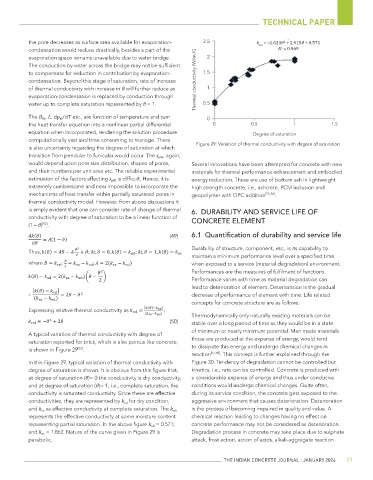
           A typical variation of thermal conductivity with degree of
           saturation reported for brick, which is also porous like concrete,   those are produced at the expense of energy, would tend
                           [52]
           is shown in Figure 29 .                                to dissipate this energy and undergo chemical changes in
                                                                  reaction [57,58] . This concept is further explained through the
           In this Figure 29, typical variation of thermal conductivity with   Figure 30. Tendency of degradation cannot be controlled but
           degree of saturation is shown. It is obvious from this figure that,   kinetics, i.e., rate can be controlled. Concrete is produced with
           at degree of saturation (θ)= 0 the conductivity is dry conductivity,   a considerable expense of energy and thus under conducive
           and at degree of saturation (θ)= 1, i.e., complete saturation, the   conditions would undergo chemical changes. Quite often,
           conductivity is saturated conductivity. Since these are effective   during its service condition, the concrete gets exposed to the
           conductivities, they are represented by k ed  for dry condition,   aggressive environment that causes deterioration. Deterioration
           and k es  as effective conductivity at complete saturation. The k em    is the process of becoming impaired in quality and value. A
           represents the effective conductivity at some moisture content   chemical reaction leading to changes having no effect on
           representing partial saturation. In the above figure k ed  = 0.571;   concrete performance may not be considered as deterioration.
           and k es  = 1.863. Nature of the curve given in Figure 29 is   Degradation process in concrete may take place due to sulphate
           parabolic.                                             attack, frost action, action of acids, alkali-aggregate reaction


                                                                            THE INDIAN CONCRETE JOURNAL | JANUARY 2026  31

