


Page 25 - ICJ Jan 2026
P. 25
TECHNICAL PAPER


           like enclosed pores, the specific surface for sphere of radius   surface area of evaporating surface of pendular water at a
                         9
           15 nm, 3 / 15 × 10 /m, and corresponding values of k v  are shown   given degree of saturation is related to (dp – t) . For example,
                                                                                                      2

                                                                                                 2
           in the Table 17 for two temperatures. Value reported of k v  by   for sphere surface area is s pW  = 4p (r – t)  and for cylinder s pW

                                               [38]
           Pratt for moist sand is 0.014 W/m.K at 23.8 °C . Values may be   involves a square of dimension term involving length and radius.
           much higher depending upon s pW .                      Usually fraction of enclosed pore is high, thus; for the purpose
                                                                  of explanation consider only the spherical pore analogy. Hence,
           The evaporation-condensation mechanism thus contributes   simply one can write s pW  = dp  (1 –cθ) . Therefore, k v (θ) = f(−θ),
                                                                                               2
                                                                                        2
           significantly to heat transfer within partially saturated porous   i.e., decreasing function of θ. As degree of saturation, increases
           material as illustrated through above example. As pendular   heat transfer due to evaporation-condensation would reduce
           water is adhered to the solid surface on one side and exposed   and possibility of a quadratic relationship appears to exist
           to air on the other, the layers of water and air form a series   as indicted by Jakob’s factors. To explain, as the degree of
           combination across the heat conduction path within pore, both   saturation increases beyond pendular water, a funicular state
           in case of enclosed as well as enclosing pores. The evaporation-  allowing bridge formation by liquid water across the solid
           condensation heat transfer is parallel to above series path as   establishing continuous water path isolating air bubbles attains
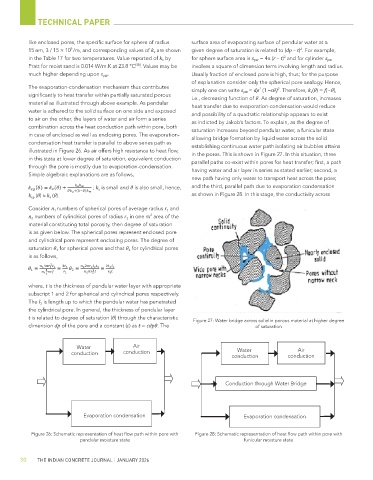
           illustrated in Figure 26. As air offers high resistance to heat flow,   in the pores. This is shown in Figure 27. In this situation, three
           in this state at lower degree of saturation, equivalent conduction   parallel paths co-exist within pores for heat transfer; first, a path
           through the pore is mostly due to evaporation-condensation.   having water and air layer in series as stated earlier; second, a
           Simple algebraic explanations are as follows,
                                                                  new path having only water to transport heat across the pore;
                                 ; k a  is small and θ is also small, hence,   and the third, parallel path due to evaporation condensation
           k ep  (θ) ≈ k v  (θ).                                  as shown in Figure 28. In this stage, the conductivity across

           Consider n 1  numbers of spherical pores of average radius r 1  and
           n 2  numbers of cylindrical pores of radius r 2  in one m  area of the
                                                    2
           material constituting total porosity, then degree of saturation
           is as given below. The spherical pores represent enclosed pore
           and cylindrical pore represent enclosing pores. The degree of
           saturation θ 1  for spherical pores and that θ 2  for cylindrical pores
           is as follows,


           where, t is the thickness of pendular water layer with appropriate
           subscript 1 and 2 for spherical and cylindrical pores respectively.
           The l 2  is length up to which the pendular water has penetrated
           the cylindrical pore. In general, the thickness of pendular layer
           t is related to degree of saturation (θ) through the characteristic   Figure 27: Water bridge across solid in porous material at higher degree
           dimension dp of the pore and a constant (c) as t = cdpθ. The                of saturation


                           Water              Air                                                    Air
                         conduction        conduction                            Water            conduction
                                                                               conduction


                                                                             Conduction through Water Bridge


                             Evaporation condensation                              Evaporation condensation


            Figure 26: Schematic representation of heat flow path within pore with   Figure 28: Schematic representation of heat flow path within pore with
                            pendular moisture state                                funicular moisture state


        30    THE INDIAN CONCRETE JOURNAL | JANUARY 2026

