


Page 24 - ICJ Jan 2026
P. 24
TECHNICAL PAPER


           conductivity of pore would increase. The contribution of solid
           portions to effective conductivity of moist porous material
                                                                          Solid
           remains unchanged with increase in moisture content from     continuity                      Pendular water
           dry state. Moisture contents, both mass and volumetric basis,
           involve dry mass and volume of the sample, respectively. The
                                                                    Pore
           density, i.e. mass / volume, varies from material to material   continuity                  Nearly enclosed
           depending upon solid type and their specific gravity. Hence,                                     solid
           as a general concept, relative degree of saturation is a better   Wide pore                  Pores without
           parameter that can be related to thermal conductivity of   with narrow                       narrow neck
                                                                      necks
           partially saturated porous material against moisture content.
           Degree of saturation or relative moisture content is defined as   Figure 25: Pendular water in porous material at lower degree of
                                                                                        saturation
           the ratio of moisture content divided by saturation moisture
           content. Thus, degree of saturation, θ =   , where M stands
                                                                                             2
           for mass of the sample and subscripts m, d, and s represent   where, q W  is the vapor flux in kg/m s; C W  is the vapor
                                                                                   3
           moist, dry and saturated states, respectively. The degree of   concentration in kg/m ; x is the space dimension along direction
                                                                                                               2
           saturation is normalized with respect to maximum absorption   of heat flow, and D W  is the vapor diffusion coefficient in m /s.
           possible, general to all material and non-dimensional. Jakob   C W  is expressed in terms of partial pressure of vapor i.e. vapor
           factor increases at a faster rate initially with moisture content   pressure and temperature as vapor follows Ideal Gas Law.
           compared to the rate at higher moisture content. This is                                              (46)
           a general observation reported in literature [31,52] . It follows
           therefore that as θ increases from 0 towards 1, initially the   where, M W  is the mass of water vapor, V is the volume, p W  is the
           rate of increase of moist thermal conductivity with degree of   vapor pressure, and R W  is the specific gas constant of water
           saturation dk/dθ of porous material such as concrete or brick   vapor. Thus,
           etc., is high and tends to reduce gently near θ, when equals
           to unity. Convection in small pores is negligible as ratio of size                                    (47)
           of the pores to molecular size of water is not large enough   Consider s pW  as the exposed surface area of pendular water in
           for occurrence of convective circulation of water. Temperature   the pores available for evaporation per unit area of the material,
           difference across the pore under ambient condition is small   and L is the latent heat of evaporation. Then the heat flux and
           for significant radiative heat transfer manifestation. There   contribution of evaporation-condensation to equivalent pore
           are three possible contributing mechanisms to effective heat   conductivity are q and k v  as given below,
           conduction in pores in partially saturated pores. The first one
           is heat conduction through water occupying the pore space by
           displacing the air. The second mechanism is heat conduction                                           (48)
           through yet to be replaced air in the pore. The third possible
           mechanism of heat transfer is evaporation and absorption of
           latent heat at the water surface inside pore and transport of   The D W , L, dp W /dT are function of temperature and the value of
           vapor under pressure gradient to cooler pore space followed   k' v  at 25 °C and 60 °C are given in Table 17; with universal gas
           by latent heat transfer by condensation. At lower degree of   constant(R) = 8.314 J/K.mol, and hence R W  = 8.314 / 18.015 ×
           saturation initially, pores partially filled with water are in a   1000 = 461.5 J/kg.K.
           pendular state, and the liquid water adheres to the solid surface
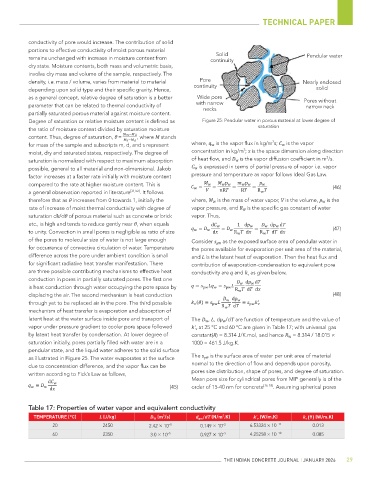
           as illustrated in Figure 25. The water evaporates at the surface   The s pW  is the surface area of water per unit area of material
           due to concentration difference, and the vapor flux can be   normal to the direction of flow and depends upon porosity,
           written according to Fick’s Law as follows,            pores size distribution, shape of pores, and degree of saturation.
                                                                  Mean pore size for cylindrical pores from MIP generally is of the
                                                          (45)    order of 15-40 nm for concrete [16-18] . Assuming spherical pores


           Table 17: Properties of water vapor and equivalent conductivity
                                                        2
            TEMPERATURE (°C)       L (J/kg)         D W  (m /s)    d pw /dT (N/m .K)  k' v  (W/m.K)    k v  (θ) (W/m.K)
                                                                            2
                   20               2450           2.42 × 10 –5      0.149 × 10 –3   6.53324 × 10 −11     0.013
                   60               2350            3.0 × 10 –5      0.927 × 10 –3   4.25258 × 10 −10     0.085


                                                                            THE INDIAN CONCRETE JOURNAL | JANUARY 2026  29

