


Page 22 - ICJ Jan 2026
P. 22
TECHNICAL PAPER


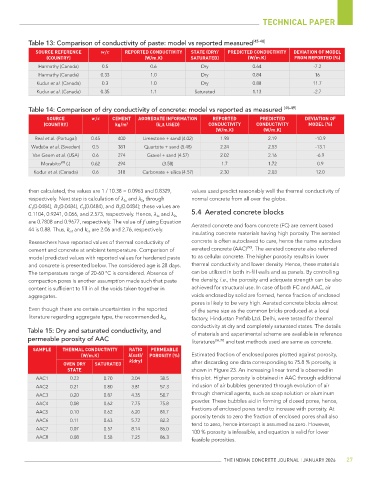
           Table 13: Comparison of conductivity of paste: model vs reported measured  [45-48]
             SOURCE REFERENCE      w/c     REPORTED CONDUCTIVITY   STATE (DRY/   PREDICTED CONDUCTIVITY   DEVIATION OF MODEL
                 (COUNTRY)                        (W/m.K)        SATURATED)          (W/m.K)        FROM REPORTED (%)
              Harmathy (Canada)    0.5              0.6              Dry              0.64                 -7.2
              Harmathy (Canada)    0.33             1.0              Dry              0.84                 16
             Kudur et al. (Canada)  0.3             1.0              Dry              0.88                 11.7
             Kudur et al. (Canada)  0.35            1.1            Saturated          1.13                 -2.7

           Table 14: Comparison of dry conductivity of concrete: model vs reported as measured   [45-49]
                 SOURCE         w/c    CEMENT   AGGREGATE INFORMATION    REPORTED        PREDICTED      DEVIATION OF
                (COUNTRY)               kg/m 3        (k s A USED)     CONDUCTIVITY    CONDUCTIVITY      MODEL (%)
                                                                          (W/m.K)         (W/m.K)
             Real et al. (Portugal)  0.45  400   Limestone + sand (4.02)   1.98            2.19            -10.9
            Wadsöa et al. (Sweden)  0.5  381      Quartzite + sand (5.48)  2.24            2.53            -13.1
            Van Geem et al. (USA)  0.6   274       Gravel + sand (4.57)    2.02            2.16             -6.9
                     [49]
               Morabito  (-)    0.62     294            (3.58)              1.7            1.72             0.9
            Kodur et al. (Canada)  0.6   318     Carbonate + silica (4.57)  2.30           2.03             12.0


           then calculated, the values are 1 / 10.38 = 0.0963 and 0.8329,   values used predict reasonably well the thermal conductivity of
           respectively. Next step is calculation of λ 1s  and λ 2s  through   normal concrete from all over the globe.
           C 1 (0.0484), D 1 (0.0484), C 2 (0.0484), and D 2 (0.0484); these values are
           0.1104, 0.9241, 0.066, and 2.573, respectively. Hence, λ 1s  and λ 2s    5.4  Aerated concrete blocks
           are 0.7808 and 0.9677, respectively. The value of f using Equation   Aerated concrete and foam concrete (FC) are cement based
           44 is 0.88. Thus, k ed  and k es  are 2.06 and 2.76, respectively.
                                                                  insulating concrete materials having high porosity. The aerated
           Researchers have reported values of thermal conductivity of   concrete is often autoclaved to cure, hence the name autoclave
                                                                                    [50]
           cement and concrete at ambient temperature. Comparison of   aerated concrete (AAC) . The aerated concrete also referred
           model predicted values with reported values for hardened paste   to as cellular concrete. The higher porosity results in lower
           and concrete is presented below. The considered age is 28 days.   thermal conductivity and lower density. Hence, these materials
           The temperature range of 20-60 °C is considered. Absence of   can be utilized in both in-fill walls and as panels. By controlling
           compaction pores is another assumption made such that paste   the density, i.e., the porosity and adequate strength can be also
           content is sufficient to fill in all the voids taken together in   achieved for structural use. In case of both FC and AAC, air
           aggregates.                                            voids enclosed by solid are formed, hence fraction of enclosed
                                                                  pores is likely to be very high. Aerated concrete blocks almost
           Even though there are certain uncertainties in the reported   of the same size as the common bricks produced at a local

           literature regarding aggregate type, the recommended k sA   factory, Hindustan Prefab Ltd. Delhi, were tested for thermal
                                                                  conductivity at dry and completely saturated states. The details
          Table 15: Dry and saturated conductivity, and
                                                                  of materials and experimental scheme are available in reference
          permeable porosity of AAC                               literatures [36,39]  and test methods used are same as concrete.
            SAMPLE    THERMAL CONDUCTIVITY   RATIO   PERMEABLE
                            (W/m.K)         k(sat)/  POROSITY (%)  Estimated fraction of enclosed pores plotted against porosity,
                                             k(dry)               after discarding one data corresponding to 75.8 % porosity, is
                      OVEN DRY   SATURATED
                        STATE                                     shown in Figure 23. An increasing linear trend is observed in
             AAC1        0.23       0.70     3.04      38.5       this plot. Higher porosity is obtained in AAC through additional
             AAC2        0.21       0.80     3.81      57.3       inclusion of air bubbles generated through evolution of air
             AAC3        0.20       0.87     4.35      58.7       through chemical agents, such as soap solution or aluminum
                                                                  powder. These bubbles aid in forming of closed pores, hence,
             AAC4        0.08       0.62     7.75      75.8
                                                                  fractions of enclosed pores tend to increase with porosity. At
             AAC5        0.10       0.62     6.20      81.7
                                                                  porosity tends to zero the fraction of enclosed pores shall also
             AAC6        0.11       0.63     5.72      82.3
                                                                  tend to zero, hence intercept is assumed as zero. However,
             AAC7        0.07       0.57     8.14      86.0
                                                                  100 % porosity is infeasible, and equation is valid for lower
             AAC8        0.08       0.58     7.25      86.3
                                                                  feasible porosities.
                                                                            THE INDIAN CONCRETE JOURNAL | JANUARY 2026  27

