


Page 18 - ICJ Jan 2026
P. 18
TECHNICAL PAPER


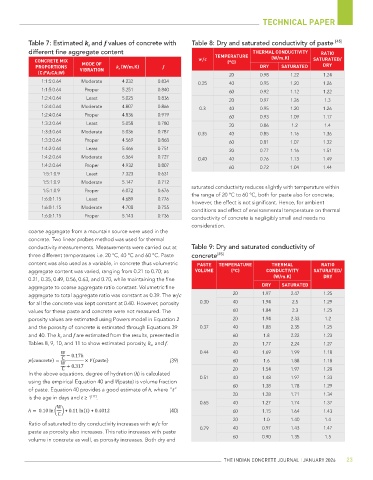
           Table 7: Estimated k  and f values of concrete with    Table 8: Dry and saturated conductivity of paste  [45]
                               s
           different fine aggregate content                               TEMPERATURE  THERMAL CONDUCTIVITY  RATIO
             CONCRETE MIX    MODE OF                                w/c       (°C)           (W/m.K)       SATURATED/
             PROPORTIONS    VIBRATION   k s  (W/m.K)    f                                DRY    SATURATED     DRY
              (C:FA:CA:W)                                                     20         0.98      1.22       1.24
               1:1:5:0.64   Moderate      4.232       0.834         0.25      40         0.95      1.20       1.26
               1:1:5:0.64     Proper      5.251       0.840                   60         0.92      1.12       1.22
               1:2:4:0.64     Least       5.025       0.836                   20         0.97      1.26       1.3
               1:2:4:0.64   Moderate      4.807       0.866         0.3       40         0.95      1.20       1.26
               1:2:4:0.64     Proper      4.836       0.919                   60         0.93      1.09       1.17
               1:3:3:0.64     Least       5.058       0.780                   20         0.86      1.2        1.4
               1:3:3:0.64   Moderate      5.036       0.787         0.35      40         0.85      1.16       1.36
               1:3:3:0.64     Proper      4.569       0.868                   60         0.81      1.07       1.32
               1:4:2:0.64     Least       5.466       0.751                   20         0.77      1.16       1.51
               1:4:2:0.64   Moderate      6.564       0.727         0.40      40         0.76      1.13       1.49
               1:4:2:0.64     Proper      4.932       0.807                   60         0.72      1.04       1.44
               1:5:1:0.9      Least       7.323       0.631
               1:5:1:0.9    Moderate      5.147       0.712
                                                                  saturated conductivity reduces slightly with temperature within
               1:5:1:0.9      Proper      6.072       0.676
                                                                  the range of 20 °C to 60 °C, both for paste also for concrete;
               1:6:0:1.15     Least       4.689       0.776
                                                                  however, the effect is not significant. Hence, for ambient
               1:6:0:1.15   Moderate      4.708       0.755
                                                                  conditions and effect of environmental temperature on thermal
               1:6:0:1.15     Proper      5.143       0.736       conductivity of concrete is negligibly small and needs no
                                                                  consideration.
           coarse aggregate from a mountain source were used in the
           concrete. Two linear probes method was used for thermal
           conductivity measurements. Measurements were carried out at   Table 9: Dry and saturated conductivity of
           three different temperatures i.e. 20 °C, 40 °C and 60 °C. Paste   concrete [45]
           content was also used as a variable, in concrete thus volumetric   PASTE   TEMPERATURE   THERMAL   RATIO
           aggregate content was varied, ranging from 0.21 to 0.70; as   VOLUME  (°C)      CONDUCTIVITY    SATURATED/
           0.21, 0.35, 0.49, 0.56, 0.63, and 0.70, while maintaining the fine                (W/m.K)          DRY
           aggregate to coarse aggregate ratio constant. Volumetric fine                 DRY    SATURATED
           aggregate to total aggregate ratio was constant as 0.39. The w/c     20       1.97      2.47       1.25
           for all the concrete was kept constant at 0.40. However, porosity   0.30  40  1.94      2.5        1.29
           values for these paste and concrete were not measured. The           60       1.84      2.3        1.25
           porosity values are estimated using Powers model in Equation 2       20       1.94      2.33        1.2
           and the porosity of concrete is estimated through Equations 39   0.37  40     1.88      2.35       1.25
           and 40. The k s  and f are estimated from the results, presented in   60       1.8      2.22       1.23
           Tables 8, 9, 10, and 11 to show estimated porosity, k s , and f.     20       1.77      2.24       1.27
                                                                    0.44        40       1.69      1.99       1.18
                                                          (39)                  60        1.6      1.88       1.18
                                                                                20       1.54      1.97       1.28
           In the above equations, degree of hydration (h) is calculated   0.51  40      1.48      1.97       1.33
           using the empirical Equation 40 and V(paste) is volume fraction
           of paste. Equation 40 provides a good estimate of h, where “t”       60       1.38      1.78       1.29
                                                                                20       1.28      1.71       1.34
                                [17]
           is the age in days and t ≥ 1 .
                                                                    0.65        40       1.27      1.74       1.37
                                                          (40)                  60       1.15      1.64       1.43
                                                                                20        1.0      1.40        1.4
           Ratio of saturated to dry conductivity increases with w/c for
                                                                    0.79        40       0.97      1.43       1.47
           paste as porosity also increases. This ratio increases with paste
           volume in concrete as well, as porosity increases. Both dry and      60       0.90      1.35        1.5


                                                                            THE INDIAN CONCRETE JOURNAL | JANUARY 2026  23

