


Page 13 - ICJ Jan 2026
P. 13
TECHNICAL PAPER


           The effective thermal conductivity of the elementary unit   m = +1). For the special case of m → 0 for random distribution
           cells can be obtained from the effective heat flow Q X  at the   of cells, the suggested empirical relationship has been given by
           boundaries along X-axis, namely at X = 0; and X = 1 as,  earlier researchers [38,42]  and corresponds to weighted geometric
                                                                  average. Generally, k ec1  and k ec2  differ from each other by few
                                                          (17)
                                                                  orders, especially when conductivities of solid and pores differ
           where, Q X  is numerically equal to the heat inflow at X = 0 or, heat   by large order, hence geometric mean, is more appropriate. The
           outflow at X = 1. k ec , is the effective thermal conductivity of the   conductivities k ec1  and k ec2  represent lower and upper bounds of
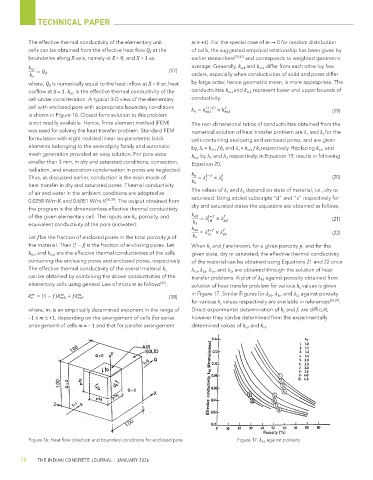
           cell under consideration. A typical 3-D view of the elementary   conductivity.
           cell with enclosed pore with appropriate boundary conditions
           is shown in Figure 16. Closed form solution to this problem                                           (19)
           is not readily available. Hence, finite element method (FEM)   The non-dimensional ratios of conductivities obtained from the
           was used for solving the heat transfer problem. Standard FEM   numerical solution of heat transfer problem are λ 1  and λ 2  for the
           formulation with eight nodded linear iso-parametric brick   cells containing enclosing and enclosed pores, and are given
           elements belonging to the serendipity family and automatic   by, λ 1  = k ec1  /   k s  and λ 2  = k ec2  /   k s  respectively. Replacing k ec1  and
           mesh generation provided an easy solution. For pore sizes   k ec2  by λ 1  and λ 2  respectively, in Equation 19, results in following
           smaller than 3 mm, in dry and saturated conditions; convection,   Equation 20,
           radiation, and evaporation-condensation in pores are neglected.
           Thus, as discussed earlier, conduction is the main mode of                                            (20)
           heat transfer in dry and saturated pores. Thermal conductivity
           of air and water in the ambient conditions are adopted as   The values of λ 1  and λ 2  depend on state of material, i.e., dry or
           0.0258 W/m.K and 0.6051 W/m.K [36,39] . The output obtained from   saturated. Using added subscripts “d” and “s” respectively for
           the program is the dimensionless effective thermal conductivity   dry and saturated states the equations are obtained as follows,
           of the given elementary cell. The inputs are k s , porosity, and                                      (21)
           equivalent conductivity of the pore (air/water).
                                                                                                                 (22)
           Let f be the fraction of enclosed pores in the total porosity p of
           the material. Then (1 – f) is the fraction of enclosing pores. Let   When k s  and f are known, for a given porosity p, and for the
           k ec1  and k ec2  are the effective thermal conductivities of the cells   given state, dry or saturated, the effective thermal conductivity
           containing the enclosing pores and enclosed pores, respectively.   of the material can be obtained using Equations 21 and 22 once
           The effective thermal conductivity of the overall material k e    λ 1d , λ 2d , λ 1s , and λ 2s  are obtained through the solution of heat
           can be obtained by combining the above conductivities of the   transfer problems. A plot of λ 1d  against porosity obtained from
           elementary cells using general Law of mixture as follows ,  solution of heat transfer problem for various k s  values is given
                                                       [42]
                                                                  in Figure 17. Similar Figures for λ 2d , λ 1s , and λ 2s  against porosity
                                                          (18)
                                                                  for various k s  values respectively are available in references [36,39] .
           where, m, is an empirically determined exponent in the range of   Direct experimental determination of k s  and f, are difficult,
           –1 ≤ m ≤ +1, depending on the arrangement of cells (for series   however they can be determined from the experimentally
           arrangement of cells m = – 1 and that for parallel arrangement   determined values of k ed  and k es .


           Figure 16: Heat flow direction and boundary conditions for enclosed pore  Figure 17: λ 1d  against porosity


        18    THE INDIAN CONCRETE JOURNAL | JANUARY 2026

