


Page 12 - ICJ Jan 2026
P. 12
TECHNICAL PAPER


           connected through regions of varying thickness. In the first   the elementary cells is likely to take place in all three orthogonal
           pore-solid configuration (enclosed pores), heat transfer occurs   dimensions even under imposed one-dimensional temperature
           predominantly through the solid skeleton, with the primary   gradient. The heat conduction at the boundaries of elementary
           role of the pores being the reduction of the effective cross-  cells is negligible in the direction other than the direction of
           sectional area available for heat flow. In contrast, in the second   heat flow and therefore ignored. The general time dependent
           configuration (enclosing pores), the pore phase interrupts the   one-dimensional equation of heat transfer is,
           solid heat-flow path, and heat transfer must occur primarily
           through the pore fluid. This results in a substantial reduction                                       (14)
           in the overall heat-transfer rate. Assumption of these two   where, ρ, C and k are the density, specific heat, and thermal
           types of pore geometry configuration provides a more realistic   conductivity of the medium respectively. T is the temperature.
           representation of heat transfer pathways and allows for an   The k is assumed to be independent of temperature but may
           extension of Ohm’s Law model concept to three dimensions.  vary in space and is isotropic at any location. It is convenient

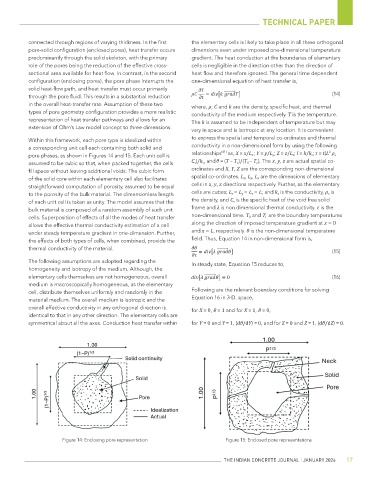
           Within this framework, each pore type is idealized within   to express the spatial and temporal co-ordinates and thermal
           a corresponding unit cell each containing both solid and   conductivity in a non-dimensional form by using the following
                                                                            [41]
                                                                                                                2
           pore phases, as shown in Figures 14 and 15. Each unit cell is   relationships  as, X = x/L x  ; Y = y/L y ; Z = z/L z ; l = k/k s ;   τ = t(L  ρ s
           assumed to be cubic so that, when packed together, the cells   C s )/k s , and   θ = (T – T L )/(T 0  – T L ). The x, y, z are actual spatial co-
           fill space without leaving additional voids. The cubic form   ordinates and X, Y, Z are the corresponding non-dimensional
           of the solid core within each elementary cell also facilitates   spatial co-ordinates. L x , L y , L z  are the dimensions of elementary
           straightforward computation of porosity, assumed to be equal   cells in x, y, z directions respectively. Further, as the elementary
           to the porosity of the bulk material. The dimensionless length   cells are cubes; L x  = L y  = L z  = L; and k s  is the conductivity, ρ s  is
           of each unit cell is taken as unity. The model assumes that the   the density, and C s  is the specific heat of the void free solid
           bulk material is composed of a random assembly of such unit   frame and λ is non dimensional thermal conductivity. τ is the
           cells. Superposition of effects of all the modes of heat transfer   non-dimensional time. T 0  and T L  are the boundary temperatures
           allows the effective thermal conductivity estimation of a cell   along the direction of imposed temperature gradient at x = 0
           under steady temperature gradient in one-dimension. Further,   and x = L, respectively. θ is the non-dimensional temperature
           the effects of both types of cells, when combined, provide the   field. Thus, Equation 14 in non-dimensional form is,
           thermal conductivity of the material.                                                                 (15)
           The following assumptions are adopted regarding the    In steady state, Equation 15 reduces to,
           homogeneity and isotropy of the medium. Although, the
           elementary cells themselves are not homogeneous, overall                                              (16)
           medium is macroscopically homogeneous, as the elementary
           cell, distribute themselves uniformly and randomly in the   Following are the relevant boundary conditions for solving
           material medium. The overall medium is isotropic and the   Equation 16 in 3-D. space,
           overall effective conductivity in any orthogonal direction is   for X = 0, θ = 1 and for X = 1, θ = 0,
           identical to that in any other direction. The elementary cells are
           symmetrical about all the axes. Conduction heat transfer within   for Y = 0 and Y = 1, (dθ/dY) = 0, and for Z = 0 and Z = 1, (dθ/dZ) = 0.


                      Figure 14: Enclosing pore representation               Figure 15: Enclosed pore representations


                                                                            THE INDIAN CONCRETE JOURNAL | JANUARY 2026  17

