


Page 6 - ICJ Jan 2026
P. 6
TECHNICAL PAPER


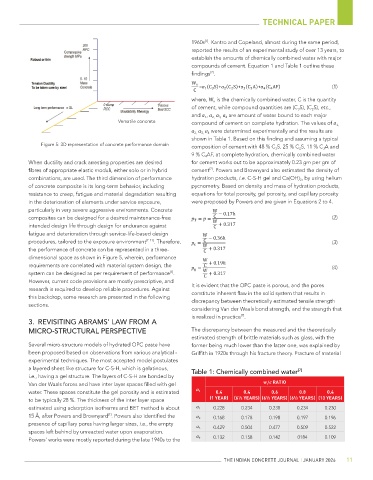
                                                                  1960s . Kantro and Copeland, almost during the same period,
                                                                      [7]
                                                                  reported the results of an experimental study of over 13 years, to
                                                                  establish the amounts of chemically combined water with major
                                                                  compounds of cement. Equation 1 and Table 1 outline these
                                                                        [7]
                                                                  findings .
                                                                                                                 (1)
                                                                  where, W n  is the chemically combined water, C is the quantity
                                                                  of cement, while compound quantities are (C 3 S), (C 2 S), etc.,
                                                                  and a 1 , a 2,  a 3,  a 4  are amount of water bound to each major
                                         Versatile concrete       compound of cement on complete hydration. The values of a 1,
                                                                  a 2,  a 3,  a 4  were determined experimentally and the results are
                                                                  shown in Table 1. Based on this finding and assuming a typical
               Figure 5: 3D representation of concrete performance domain  composition of cement with 48 % C 3 S, 25 % C 2 S, 11 % C 3 A and
                                                                  9 % C 4 AF, at complete hydration, chemically combined water
           When ductility and crack arresting properties are desired   for cement works out to be approximately 0.23 gm per gm of
                                                                        [7]
           fibres of appropriate elastic moduli, either solo or in hybrid   cement . Powers and Brownyard also estimated the density of
           combinations, are used. The third dimension of performance   hydration products, i.e. C-S-H gel and Ca(OH) 2 , by using helium
           of concrete composite is its long-term behavior, including   pycnometry. Based on density and mass of hydration products,
           resistance to creep, fatigue and material degradation resulting   equations for total porosity, gel porosity, and capillary porosity
           in the deterioration of elements under service exposure,   were proposed by Powers and are given in Equations 2 to 4.
           particularly in very severe aggressive environments. Concrete
           composites can be designed for a desired maintenance-free                                             (2)
           intended design life through design for endurance against
           fatigue and deterioration through service-life-based design
           procedures, tailored to the exposure environment [7-11] . Therefore,                                  (3)
           the performance of concrete can be represented in a three-
           dimensional space as shown in Figure 5, wherein, performance
           requirements are correlated with material system design, the                                          (4)
                                                          [1]
           system can be designed as per requirement of performance .
           However, current code provisions are mostly prescriptive, and   It is evident that the OPC paste is porous, and the pores
           research is required to develop reliable procedures. Against
           this backdrop, some research are presented in the following   constitute inherent flaw in the solid system that results in
           sections.                                              discrepancy between theoretically estimated tensile strength
                                                                  considering Van der Waals bond strength, and the strength that
                                                                                  [7]
                                                                  is realized in practice .
           3.  REVISITING ABRAMS’ LAW FROM A
           MICRO-STRUCTURAL PERSPECTIVE                           The discrepancy between the measured and the theoretically
                                                                  estimated strength of brittle materials such as glass, with the
           Several micro-structure models of hydrated OPC paste have   former being much lower than the latter one, was explained by
           been proposed based on observations from various analytical -   Griffith in 1920s through his fracture theory. Fracture of material
           experimental techniques. The most accepted model postulates
           a layered sheet like structure for C-S-H, which is gelatinous,   Table 1: Chemically combined water [7]
           i.e., having a gel structure. The layers of C-S-H are bonded by
           Van der Waals forces and have inter layer spaces filled with gel               w/c RATIO
           water. These spaces constitute the gel porosity and is estimated   a 1  0.4  0.4    0.6    0.8      0.4
           to be typically 28 %. The thickness of the inter layer space   (1 YEAR)  (6½ YEARS) (6½ YEARS) (6½ YEARS) (13 YEARS)
           estimated using adsorption isotherms and BET method is about   a 1  0.228  0.234  0.238   0.234     0.230
           15 Å, after Powers and Brownyard . Powers also identified the   a 2  0.168  0.178  0.198  0.197     0.196
                                     [7]
           presence of capillary pores having larger sizes, i.e., the empty
                                                                   a 3   0.429    0.504     0.477    0.509     0.522
           spaces left behind by unreacted water upon evaporation.
           Powers’ works were mostly reported during the late 1940s to the   a 4  0.132  0.158  0.142  0184    0.109


                                                                            THE INDIAN CONCRETE JOURNAL | JANUARY 2026  11

