


Page 5 - ICJ Jan 2026
P. 5
TECHNICAL PAPER


           generalization. Technology refers to machinery, arrangement                                           2050
           and procedures used by human The development of concrete                                          ?
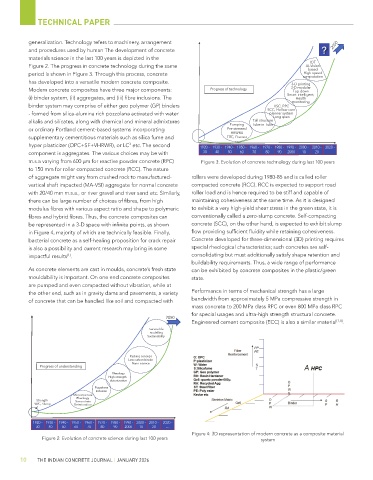
           materials science in the last 100 years is depicted in the
                                                                                                          IOT
           Figure 2. The progress in concrete technology during the same                                AI-Vision
                                                                                                         based
                                                                                                       High speed
           period is shown in Figure 3. Through this process, concrete                                 computation
           has developed into a versatile modern concrete composite.                               3-D printing
           Modern concrete composites have three major components:      Progress of technology     3-D modular
                                                                                                    Top down
                                                                                                  Smart-intelligent,
           (i) binder system, (ii) aggregates, and (iii) fibre inclusions. The                       Health
                                                                                                    monitoring
           binder system may comprise of either geo polymer (GP) binders                     HSC, RPC
                                                                                           SCC, Hollow core
           - formed from silica-alumina rich pozzolana activated with water                 planner system
                                                                                             Long span
           alkalis and silicates, along with chemical and mineral admixtures          Tall structure
                                                                              Pumping  Tube in Tube
           or ordinary Portland cement-based systems incorporating            Pre-stressed
                                                                               HRWRA
           supplementary cementitious materials such as silica fume and       FRC, Precast
           hyper plasticizer (OPC+SF+VHRWR), or LC  etc. The second   1920 -  1930 -  1940 -  1950 -  1960 -  1970 -  1980 -  1990 -  2000 -  2010 -  2020 -
                                             3
           component is aggregates. The various choices may be with   30  40  50  60  70   80  90  2000  10  20  ---
           m.s.a varying from 600 mm for reactive powder concrete (RPC)   Figure 3: Evolution of concrete technology during last 100 years
           to 150 mm for roller compacted concrete (RCC). The nature
           of aggregate might vary from crushed rock to manufactured-  rollers were developed during 1980-85 and is called roller
           vertical shaft impacted (MA-VSI) aggregate for normal concrete   compacted concrete (RCC). RCC is expected to support road
           with 20/40 mm m.s.a., or river gravel and river sand etc. Similarly,   roller load and is hence required to be stiff and capable of
           there can be large number of choices of fibres, from high   maintaining cohesiveness at the same time. As it is designed
           modulus fibres with various aspect ratio and shape to polymeric   to exhibit a very high-yield shear stress in the green state, it is
           fibres and hybrid fibres. Thus, the concrete composites can   conventionally called a zero-slump concrete. Self-compacting
           be represented in a 3-D space with infinite points, as shown   concrete (SCC), on the other hand, is expected to exhibit slump
           in Figure 4, majority of which are technically feasible. Finally,   flow providing sufficient fluidity while retaining cohesiveness.
           bacterial concrete as a self-healing proposition for crack repair   Concrete developed for three-dimensional (3D) printing requires
           is also a possibility and current research may bring in some   special rheological characteristics; such concretes are self-
                        [1]
           impactful results .                                    consolidating but must additionally satisfy shape retention and
                                                                  buildability requirements. Thus, a wide range of performance
           As concrete elements are cast in moulds, concrete’s fresh state   can be exhibited by concrete composites in the plastic/green
           mouldability is important. On one end concrete composites   state.
           are pumped and even compacted without vibration, while at
           the other end, such as in gravity dams and pavements, a variety   Performance in terms of mechanical strength has a large
           of concrete that can be handled like soil and compacted with   bandwidth from approximately 5 MPa compressive strength in
                                                                  mass concrete to 200 MPa class RPC or even 800 MPa class RPC
                                                                  for special usages and ultra-high strength structural concrete.
                                                         2050
                                                                  Engineered cement composite (ECC) is also a similar material [1,4] .
                                                   Service life
                                                    modelling
                                                   Sustainability


                                             Packingconcept
                                            Lowcarbonbinder
                                             Nano science
              Progress of understanding
                                       Rheology
                                      High strength -
                                      deterioration
                                 Pozzolana
                                 inclusion
                          Microstructure
                           Rheology
             Strength-    Stress-strain
             W/C, Slump   Deterioration
            1920 -  1930 -  1940 -  1950 -  1960 -  1970 -  1980 -  1990 -  2000 -  2010 -  2020 -
             30  40   50  60   70  80  90  2000  10  20  ---
                                                                  Figure 4: 3D representation of modern concrete as a composite material
               Figure 2: Evolution of concrete science during last 100 years             system


        10    THE INDIAN CONCRETE JOURNAL | JANUARY 2026

