


Page 11 - ICJ Feb Openaccess 2026
P. 11
TECHNICAL PAPER


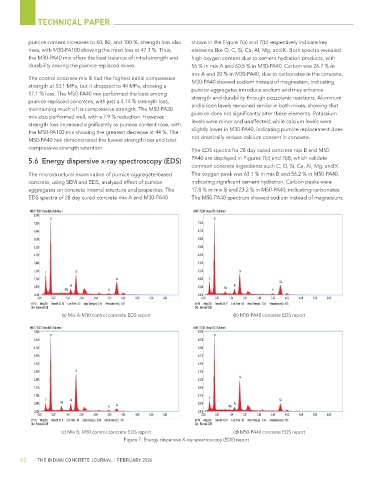
           pumice content increases to 60, 80, and 100 %, strength loss also   shown in the Figure 7(a) and 7(b) respectively indicate key
           rises, with M30-PA100 showing the most loss at 47.1 %. Thus,   elements like O, C, Si, Ca, Al, Mg, and K. Both spectra revealed
           the M30-PA40 mix offers the best balance of initial strength and   high oxygen content due to cement hydration products, with
           durability among the pumice-replaced mixes.            56 % in mix A and 60.5 % in M30-PA40. Carbon was 26.7 % in
                                                                  mix A and 20 % in M30-PA40, due to carbonates in the concrete.
           The control concrete mix B had the highest initial compressive   M30-PA40 showed sodium instead of magnesium, indicating
           strength at 53.1 MPa, but it dropped to 44 MPa, showing a
           17.1 % loss. The M50-PA40 mix performed the best among   pumice aggregates introduce sodium and may enhance
           pumice-replaced concretes, with just a 4.14 % strength loss,   strength and durability through pozzolanic reactions. Aluminum
           maintaining much of its compressive strength. The M50-PA20   and silicon levels remained similar in both mixes, showing that
           mix also performed well, with a 7.9 % reduction. However,   pumice does not significantly alter these elements. Potassium
           strength loss increased significantly as pumice content rose, with   levels were minor and unaffected, while calcium levels were
           the M50-PA100 mix showing the greatest decrease at 44 %. The   slightly lower in M30-PA40, indicating pumice replacement does
           M50-PA40 mix demonstrated the lowest strength loss and best   not drastically reduce calcium content in concrete.
           compressive strength retention.                        The EDS spectra for 28 day cured concrete mix B and M50-

                                                                  PA40 are displayed in Figures 7(c) and 7(d), which validate
           5.6  Energy dispersive x-ray spectroscopy (EDS)
                                                                  common concrete ingredients such C, O, Si, Ca, Al, Mg, and K.
           The microstructural examination of pumice aggregate-based   The oxygen peak was 63.1 % in mix B and 56.2 % in M50-PA40,
           concrete, using SEM and EDS, analyzed effect of pumice   indicating significant cement hydration. Carbon peaks were
           aggregates on concrete internal structure and properties. The   17.8 % in mix B and 23.2 % in M50-PA40, indicating carbonates.
           EDS spectra of 28 day cured concrete mix A and M30-PA40   The M50-PA40 spectrum showed sodium instead of magnesium,


                      (a) Mix A-M30 control concrete EDS report                 (b) M30-PA40 concrete EDS report


                      (c) Mix B, M50 control concrete EDS report                (d) M50-PA40 concrete EDS report
                                           Figure 7: Energy-dispersive X-ray spectroscopy (EDS) report


        62    THE INDIAN CONCRETE JOURNAL | FEBRUARY 2026

