


Page 7 - ICJ Feb Openaccess 2026
P. 7
TECHNICAL PAPER


                                                                  A superplasticizer equivalent to 1 % of the cement weight was
                                   Start
                                                                  utilised. As pumice absorbed water, the water content increased
                                    ↓
                                                                  due to coarse aggregate replacement with pumice. The findings
                           Testing of Materials Used              of the slump cone test revealed that the concrete of grade
                             In Experimental Study
                                                                  M30 attained a slump of 120 mm, whereas grade M50 attained
                                    ↓
                                                                  125 mm. Control concrete (CC) refers to the normal mixes for
                             Mix Design M30 and                   both M30 and M50 grades that do not contain any pumice
                            M50 Control Concrete
                                                                  substitution. For the M30 and M50 concrete mixes, various
                                    ↓
                                                                  replacement percentages of normal coarse aggregate (NCA) by
                       Casting of Samples Cubes for Control       lightweight pumice coarse aggregate (PCA) were assessed at 20,
                       Concrete and Pumice Based Concrete
                                                                  40, 60, 80, and 100 %.
                                    ↓
                               28 Days Curing                     5.2  Compressive strength test
                                    ↓
                                                                  Three cubes measuring 150 × 150 × 150 mm each were
              Mechanical Tests                                    produced for the M30 and M50 control concrete samples. In
              1.  Compressive Strength Test To Determine Optimal Dosage
                of Pumice CA 1.                                   addition, three 150 × 150 × 150 mm cube samples were cast
              2.  Tensile Strength Test                           for every percentage that the pumice coarse aggregate was
              3.  Modulus of Rupture Test
                                                                  replaced with. Based on the results of the compressive strength
                                    ↓                             test, the ideal dosage of lightweight pumice coarse aggregate
                        Acid resistance test for durability &     (PCA) for the M30 and M50 classes of concrete was established.
                     Microstructural Analysis (Scanning Electron
                    Microscopy (SEM), X-Ray Diffraction (XRD), and    Designations given to the different replacement mix proportions
                       Energy Dispersive Spectroscopy (EDS)       is as shown in Table 4.
                                    ↓
                                                                  It was found that the concrete’s compressive strength dropped
                            Results and Discussions               as pumice substitution increased. The data is as shown in
                                    ↓                             Figures 3(a) and 3(b).
                                Conclusions                       The M30 and M50 concrete mixes’ compressive strength at

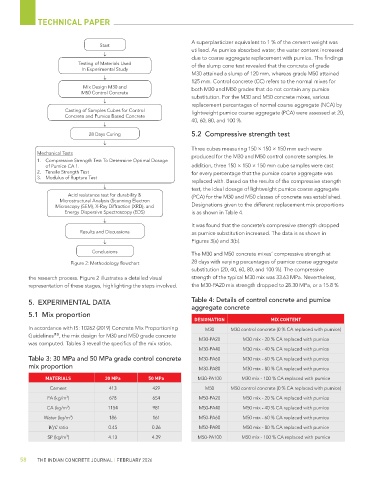
                         Figure 2: Methodology flowchart          28 days with varying percentages of pumice coarse aggregate
                                                                  substitution (20, 40, 60, 80, and 100 %). The compressive
           the research process. Figure 2 illustrates a detailed visual   strength of the typical M30 mix was 33.63 MPa. Nevertheless,
           representation of these stages, highlighting the steps involved.  the M30-PA20 mix strength dropped to 28.30 MPa, or a 15.8 %

           5.  EXPERIMENTAL DATA                                  Table 4: Details of control concrete and pumice
                                                                  aggregate concrete
           5.1  Mix proportion
                                                                   DESIGNATION              MIX CONTENT
           In accordance with IS: 10262 (2019) Concrete Mix Proportioning   M30  M30 control concrete (0 % CA replaced with pumice)
           Guidelines [13] , the mix design for M30 and M50 grade concrete
           was computed. Tables 3 reveal the specifics of the mix ratios.   M30-PA20  M30 mix - 20 % CA replaced with pumice
                                                                    M30-PA40       M30 mix - 40 % CA replaced with pumice
           Table 3: 30 MPa and 50 MPa grade control concrete        M30-PA60       M30 mix - 60 % CA replaced with pumice
           mix proportion                                           M30-PA80       M30 mix - 80 % CA replaced with pumice
                MATERIALS           30 MPa         50 MPa           M30-PA100     M30 mix - 100 % CA replaced with pumice
                  Cement              413           429               M50      M50 control concrete (0 % CA replaced with pumice)
                       3
                 FA (kg/m )           678           654             M50-PA20       M50 mix - 20 % CA replaced with pumice
                        3
                 CA (kg/m )          1154           981             M50-PA40       M50 mix - 40 % CA replaced with pumice
                Water (kg/m )         186           161             M50-PA60       M50 mix - 60 % CA replaced with pumice
                         3
                 W/C ratio            0.45          0.26            M50-PA80       M50 mix - 80 % CA replaced with pumice

                       3
                 SP (kg/m )           4.13          4.29            M50-PA100     M50 mix - 100 % CA replaced with pumice

        58    THE INDIAN CONCRETE JOURNAL | FEBRUARY 2026

