


Page 9 - ICJ Feb Openaccess 2026
P. 9
TECHNICAL PAPER


                                                                                         Modulus of rupture
                                                                    3.50                           3.29
                                                                            3.03
                                                                    3.00               2.58                   2.70
                                                                   Modulus of rupture (MPa)  2.00
                                                                    2.50


                                                                    1.50
                                                                    1.00
                                                                    0.50

                                                                    0.00
                                                                            M30       M30-PA40    M50       M50-PA40
                                                                                           Specimen
            (a) Universal testing machine arrangement with prism centred for loading   (b) Different M30 and M50 concrete mix modulus of rupture at 28 days
                                                      Figure 5: Modulus of rupture

           aggregate, the M30-PA40 mix’s tensile strength dramatically   durability evaluation across multiple exposure scenarios for a
           decreased to 1.42 MPa, a 59.9 % decrease. Comparably, the   comprehensive understanding.
           M50 concrete initial 3.82 MPa tensile strength decreased to 1.84
           MPa for M50-PA40 when the same 40 % pumice substitution   Concrete sample preparation and curing for a total of 28 days
           was used, signifying a 51.8 % loss. The findings showed that   was required for the sulphuric acid resistance test. We measured
           adding pumice had a negative impact on the tensile strength of   their initial weight and size. The concrete samples were
           both concrete grades, with M30 exhibiting a somewhat larger   completely immersed in a 5 % sulphuric acid solution that was
           percentage reduction than M50.                         made in non-reactive containers. The samples were submerged
                                                                  for a duration of 28 days, as seen in Figure 6(a). As seen in
           5.4  Modulus of rupture test                           Figure 6(b), the pH of the solution was checked and maintained
                                                                  once a week. Following the exposure time, the samples were
           Modulus of rupture test was performed on control concrete   taken out, carefully washed to eliminate any remaining acid,
           and optimal dosage pumice aggregate concrete. Concrete   dried, and remeasured. In addition to calculating the percentage
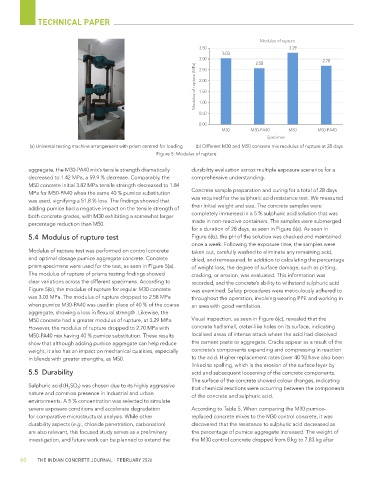
           prism specimens were used for the test, as seen in Figure 5(a).   of weight loss, the degree of surface damage, such as pitting,
           The modulus of rupture of prisms testing findings showed   cracking, or erosion, was evaluated. This information was
           clear variations across the different specimens. According to   recorded, and the concrete’s ability to withstand sulphuric acid
           Figure 5(b), the modulus of rupture for regular M30 concrete   was examined. Safety procedures were meticulously adhered to
           was 3.03 MPa. The modulus of rupture dropped to 2.58 MPa   throughout the operation, involving wearing PPE and working in
           when pumice M30-PA40 was used in place of 40 % of the coarse   an area with good ventilation.
           aggregate, showing a loss in flexural strength. Likewise, the
           M50 concrete had a greater modulus of rupture, at 3.29 MPa.   Visual inspection, as seen in Figure 6(c), revealed that the
           However, the modulus of rupture dropped to 2.70 MPa with   concrete had small, crater-like holes on its surface, indicating
           M50-PA40 mix having 40 % pumice substitution. These results   localised areas of intense attack where the acid had dissolved
           show that although adding pumice aggregate can help reduce   the cement paste or aggregate. Cracks appear as a result of the
           weight, it also has an impact on mechanical qualities, especially   concrete’s components expanding and compressing in reaction
           in blends with greater strengths, as M50.              to the acid. Higher replacement rates (over 40 %) have also been
                                                                  linked to spalling, which is the erosion of the surface layer by
           5.5  Durability                                        acid and subsequent loosening of the concrete components.
                                                                  The surface of the concrete showed colour changes, indicating
           Sulphuric acid (H 2 SO 4 ) was chosen due to its highly aggressive   that chemical reactions were occurring between the components
           nature and common presence in industrial and urban     of the concrete and sulphuric acid.
           environments. A 5 % concentration was selected to simulate
           severe exposure conditions and accelerate degradation   According to Table 5, When comparing the M30 pumice-
           for comparative microstructural analysis. While other   replaced concrete mixes to the M30 control concrete, it was
           durability aspects (e.g., chloride penetration, carbonation)   discovered that the resistance to sulphuric acid decreased as
           are also relevant, this focused study serves as a preliminary   the percentage of pumice aggregate increased. The weight of
           investigation, and future work can be planned to extend the   the M30 control concrete dropped from 8 kg to 7.83 kg after


        60    THE INDIAN CONCRETE JOURNAL | FEBRUARY 2026

