


Page 131 - ICJ Jan 2023
P. 131
TECHNICAL PAPER                                            COLLECTOR’S EDITION


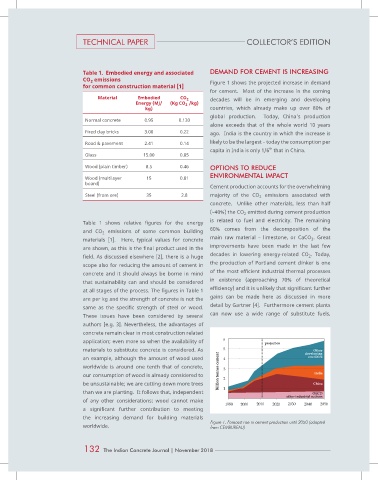
                              Table 1.  Embodied energy and associated      DEMAND FOR CEMENT IS INCREASING
                              CO  emissions                                 Figure 1 shows the projected increase in demand
                                 2
                              for common construction material [1]
                                                                            for cement.  Most of the increase in the coming
                                    Material      Embodied       CO 2       decades will  be  in  emerging and developing
                                                 Energy (MJ/  (Kg CO /kg)
                                                                   2
                                                     kg)                    countries,  which  already  make  up  over  80%  of
                                                                            global production.  Today, China’s  production
                               Normal concrete      0.95        0.130
                                                                            alone  exceeds  that  of  the  whole  world  10  years
                               Fired clay bricks    3.00         0.22       ago.  India is the country in which the increase is

                               Road & pavement      2.41         0.14       likely to be the largest – today the consumption per
                                                                                                 th
                                                                            capita in India is only 1/6  that in China.
                               Glass                15.00        0.85
                               Wood (plain timber)   8.5         0.46       OPTIONS TO REDUCE
                                                                            ENVIRONMENTAL IMPACT
                               Wood (multilayer      15          0.81
                               board)
                                                                            Cement production accounts for the overwhelming
                               Steel (from ore)      35          2.8        majority of the CO  emissions associated with
                                                                                             2
                                                                            concrete.    Unlike  other  materials,  less  than  half
                                                                            (~40%) the CO  emitted during cement production
                                                                                        2
                              Table  1  shows  relative  figures  for  the  energy   is related to fuel and electricity.  The remaining
                              and  CO  emissions of some common building    60%  comes  from  the  decomposition  of  the
                                     2
                              materials  [1].    Here,  typical  values  for  concrete   main raw material  – limestone,  or CaCO . Great
                                                                                                               3
                              are shown, as this is the final product used in the   improvements have been made in the last few
                              field. As discussed elsewhere [2], there is a huge   decades in lowering energy-related  CO . Today,
                                                                                                              2
                              scope also for reducing the amount of cement in   the production of Portland cement clinker is one
                              concrete  and it  should always  be borne in mind   of the most efficient industrial thermal processes
                              that sustainability  can and  should be considered   in  existence  (approaching  70%  of  theoretical
                              at all stages of the process. The figures in Table 1   efficiency) and it is unlikely that significant further
                              are per kg and the strength of concrete is not the   gains can be made here as discussed in more
                              same  as  the  specific  strength  of  steel  or  wood.   detail by Gartner [4].  Furthermore cement plants
                              These issues have  been considered by  several   can now use a wide range of substitute fuels,
                              authors [e.g.  3].  Nevertheless,  the  advantages  of
                              concrete remain clear in most construction related
                              application; even more so when the availability of
                              materials to substitute concrete is considered. As
                              an example, although the amount of wood used
                              worldwide is  around one  tenth  that  of  concrete,
                              our consumption of wood is already considered to
                              be unsustainable; we are cutting down more trees
                              than we are planting.  It follows that, independent
                              of any other considerations; wood cannot make
                              a  significant  further  contribution  to  meeting
                              the increasing demand for building materials
                              worldwide.


                               132 The Indian Concrete Journal | November 2018

