


Page 132 - ICJ Jan 2023
P. 132
TECHNICAL PAPER COLLECTOR’S EDITION
Table 2. Summary of suitability of common oxides for cementitious materials.
Oxide Hydrates Geology
CaO Good mobility, hydrates can fill space Limestone, widely distributed
Less soluble but still a major
SiO 2 component of space filling hydrates Most common oxide, everywhere
With silica in feldspars, clays, etc.
Al O 3 Variable solubility, hydrates fill space also more concentrated and localised as / ?
2
bauxites
Low mobility / solubility in alkaline
Fe O 3 solutions, poor contribution to space ? Very widely distributed
2
filling
Low mobility / solubility in alkaline Mainly as impurity in limestone, more
MgO solutions, poor contribution to space concentrated sources localised.
filling
reducing the need for primary fossil fuels to below prediction tools needed to assess the functional
20% in some modern plants. This versatility, the and environmental performance of new materials.
fact that the calorific value of such a wide range of
waste products can be exploited in a safe manner, The options for new cement chemistries are
should be seen as another advantage of cement ultimately limited by the composition of the earth.
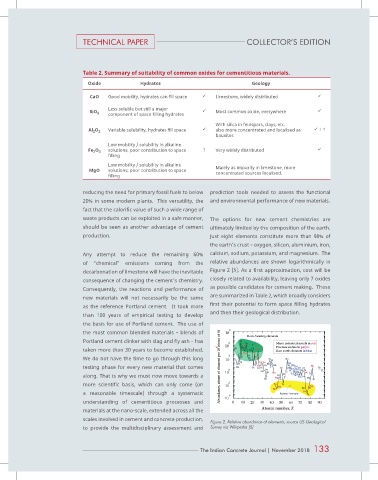
production. Just eight elements constitute more than 98% of
the earth’s crust – oxygen, silicon, aluminium, iron,
Any attempt to reduce the remaining 60% calcium, sodium, potassium, and magnesium. The
of “chemical” emissions coming from the relative abundances are shown logarithmically in
decarbonation of limestone will have the inevitable Figure 2 [5]. As a first approximation, cost will be
consequence of changing the cement’s chemistry. closely related to availability, leaving only 7 oxides
Consequently, the reactions and performance of as possible candidates for cement making. These
new materials will not necessarily be the same are summarized in Table 2, which broadly considers
as the reference Portland cement. It took more first their potential to form space filling hydrates
than 100 years of empirical testing to develop and then their geological distribution.
the basis for use of Portland cement. The use of
the most common blended materials – blends of
Portland cement clinker with slag and fly ash – has
taken more than 30 years to become established.
We do not have the time to go through this long
testing phase for every new material that comes
along. That is why we must now move towards a
more scientific basis, which can only come (on
a reasonable timescale) through a systematic
understanding of cementitious processes and
materials at the nano-scale, extended across all the
scales involved in cement and concrete production,
to provide the multidisciplinary assessment and
The Indian Concrete Journal | November 2018 133

