


Page 134 - ICJ Jan 2023
P. 134
TECHNICAL PAPER                                            COLLECTOR’S EDITION


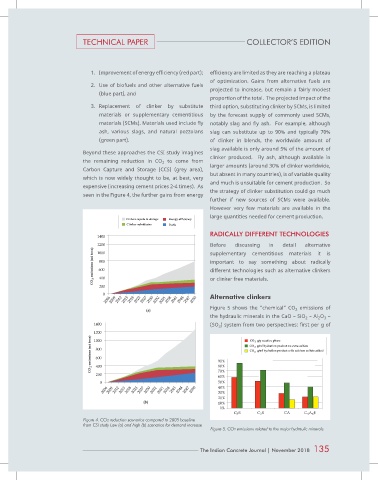
                                 1.  Improvement of energy efficiency (red part);  efficiency are limited as they are reaching a plateau
                                                                            of  optimization.  Gains  from  alternative  fuels  are
                                 2.  Use of biofuels and  other alternative fuels
                                    (blue part), and                        projected to increase, but remain a fairly modest
                                                                            proportion of the total.  The projected impact of the
                                 3.  Replacement  of  clinker  by  substitute   third option, substituting clinker by SCMs, is limited
                                    materials or supplementary cementitious   by  the  forecast  supply  of  commonly  used  SCMs,
                                    materials (SCMs). Materials used include fly   notably  slag  and  fly  ash.    For  example,  although
                                    ash,  various  slags,  and  natural  pozzolans   slag  can  substitute  up  to  90%  and  typically  70%
                                    (green part).                           of clinker in blends, the worldwide amount of
                                                                            slag available is only around 5% of the amount of
                              Beyond these approaches the CSI study imagines
                              the remaining reduction in CO  to come from   clinker produced.  Fly ash, although  available in
                                                           2
                              Carbon  Capture  and  Storage  (CCS)  (grey  area),   larger amounts (around 30% of clinker worldwide,
                              which is now widely  thought to be, at best, very   but absent in many countries), is of variable quality
                              expensive (increasing cement prices 2-4 times).  As   and much is unsuitable for cement production.  So
                              seen in the Figure 4, the further gains from energy   the strategy of clinker substitution could go much
                                                                            further  if  new  sources  of  SCMs  were  available.
                                                                            However very  few materials  are available  in the
                                                                            large quantities needed for cement production.


                                                                            RADICALLY DIFFERENT TECHNOLOGIES

                                                                            Before   discussing   in   detail   alternative
                                                                            supplementary cementitious  materials  it  is
                                                                            important  to  say  something about radically
                                                                            different technologies such as alternative clinkers
                                                                            or clinker free materials.


                                                                            Alternative clinkers
                                                                            Figure 5 shows the “chemical”  CO  emissions of
                                                                                                          2
                                                                            the hydraulic minerals in the CaO – SiO  – Al O  –
                                                                                                                    3
                                                                                                                  2
                                                                                                             2
                                                                            (SO ) system from two perspectives: first per g of
                                                                               3


                                                                        The Indian Concrete Journal | November 2018  135

