


Page 139 - ICJ Jan 2023
P. 139
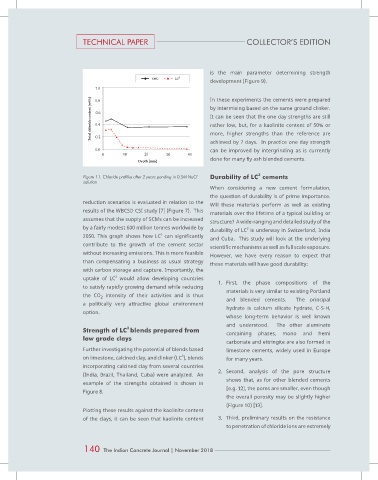
TECHNICAL PAPER                                            COLLECTOR’S EDITION


                                                                            is the main parameter determining strength
                                                                            development (Figure 9).


                                                                            In these experiments the cements were prepared
                                                                            by intermixing based on the same ground clinker.
                                                                            It can be seen that the one day strengths are still
                                                                            rather low, but, for a kaolinite content of 50% or
                                                                            more,  higher strengths than the reference are
                                                                            achieved by 7 days.  In practice one day strength
                                                                            can be improved by intergrinding  as is currently
                                                                            done for many fly ash blended cements.


                                                                                             3
                                                                            Durability of LC  cements
                                                                            When  considering a new cement formulation,
                                                                            the question of durability is of prime importance.
                              reduction scenarios is evaluated in relation to the   Will these materials perform  as well as existing
                              results of the WBCSD CSI study [7] (Figure 7).  This   materials over the lifetime of a typical building or
                              assumes that the supply of SCMs can be increased   structure?  A wide-ranging and detailed study of the
                              by a fairly modest 600 million tonnes worldwide by   durability of LC  is underway in Switzerland, India
                                                                                         3
                                                          3
                              2050. This graph shows how LC  can significantly   and Cuba.  This study will look at the underlying
                              contribute to the growth of the cement sector   scientific mechanisms as well as full scale exposure.
                              without increasing emissions. This is more feasible   However, we have every  reason to expect that
                              than compensating  a business as usual strategy   these materials will have good durability:
                              with carbon storage and capture. Importantly, the
                                          3
                              uptake  of  LC  would allow developing countries
                              to satisfy rapidly growing demand while reducing   1.  First,  the phase  compositions  of the
                              the  CO   intensity  of their  activities  and is  thus   materials is very similar to existing Portland
                                     2
                              a politically  very attractive  global environment   and blended cements.  The principal
                              option.                                            hydrate  is  calcium  silicate  hydrate,  C-S-H,
                                                                                 whose long-term behavior is well known
                                                                                 and understood.  The other aluminate
                                              3
                              Strength of LC blends prepared from                containing phases, mono and hemi
                              low grade clays
                                                                                 carbonate and ettringite are also formed in
                              Further investigating the potential of blends based   limestone cements, widely used in Europe
                                                                  3
                              on limestone, calcined clay, and clinker (LC ), blends   for many years.
                              incorporating calcined clay from several countries
                                                                              2.  Second,  analysis  of  the  pore  structure
                              (India, Brazil, Thailand, Cuba) were analyzed.  An
                                                                                 shows  that,  as  for other  blended cements
                              example  of  the  strengths obtained  is  shown in
                                                                                 [e.g. 12], the pores are smaller, even though
                              Figure 8.
                                                                                 the overall porosity may be slightly higher
                                                                                 (Figure 10) [13].
                              Plotting these results against the kaolinite content
                              of the clays, it can be seen that kaolinite content   3.  Third, preliminary results on the resistance
                                                                                 to penetration of chloride ions are extremely


                               140 The Indian Concrete Journal | November 2018

