


Page 137 - ICJ Jan 2023
P. 137
TECHNICAL PAPER COLLECTOR’S EDITION
rice husk ash, can be interesting, but the quantities of clinker can offset the cost of calcination. This is
available are relatively small and localised (both because the aluminate component of the calcined
geographically and to certain periods of the year). clay can react with calcium carbonate (limestone)
There are extensive reserves of natural pozzolans and calcium hydroxide to produce space filling
worldwide (e.g. volcanic ashes), but generally carbo aluminate hydrates:
these have a fairly low reactivity and are very
variable from place to place. The one material A (from calcined clay) + Cc + 3CH C A.Cc.H 11
3
which has a real potential to make a significant
contribution to lowering the clinker (and so CO Clays are the weathering product of all rock types
2
emissions) of cement is clay, which becomes and as such are abundantly available close to the
reactive when calcined at temperatures between earth’s surface in all geological settings. They
600 – 800°C.
are made up of silicon and aluminium oxides,
which together constitute around three quarters
The use of calcined clays as pozzolans has been of the earth’s crust. The most suitable clay types,
known for some time, it was widely used in India in those containing kaolinite, are typical in tropical
the 1970s (before fly ash was widely available) and is and subtropical environments, where most of the
currently being used in countries without supplies increase in demand for cement is forecast to occur.
of the common SCMs, notably Brazil. However, Kaolinite clay occurs in abundance in association
substitution just as a pozzolan is only practical up with soils that have formed from the chemical
to about 30%, at which level the cost of calcination weathering of rocks in hot, moist climates, Alfisols
usually does not make this an economically (pale green) and Ultisols (yellow) on the map
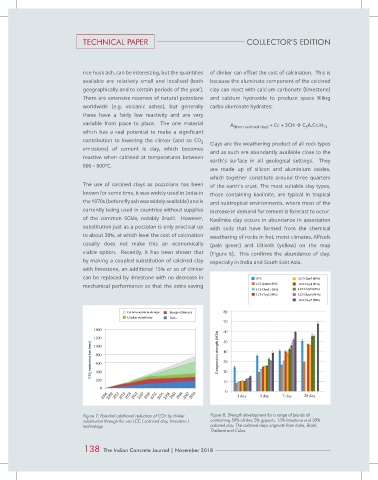
viable option. Recently, it has been shown that (Figure 6). This confirms the abundance of clay,
by making a coupled substitution of calcined clay especially in India and South East Asia.
with limestone, an additional 15% or so of clinker
can be replaced by limestone with no decrease in
mechanical performance so that the extra saving
138 The Indian Concrete Journal | November 2018

