


Page 133 - ICJ Jan 2023
P. 133
TECHNICAL PAPER                                            COLLECTOR’S EDITION


                              The potential to form space-filling hydrates is the   insoluble hydrates, but because their mobility  in
                              key  to  a hydraulic  cement.  First,  the anhydrous   the alkaline pore solution of cements is very low,
                              cement is mixed with water. The solid content of   these  hydrates  are  almost  exclusively  deposited
                              the resulting mixture cannot exceed around 50%   within the boundaries of the original grains and do
                              (W/C ~ 0.3) if the mixture is to be flowable.  Then the   not contribute to filling the space initially occupied
                              anhydrous material must dissolve and precipitate   by water or to binding the grains together.  Even
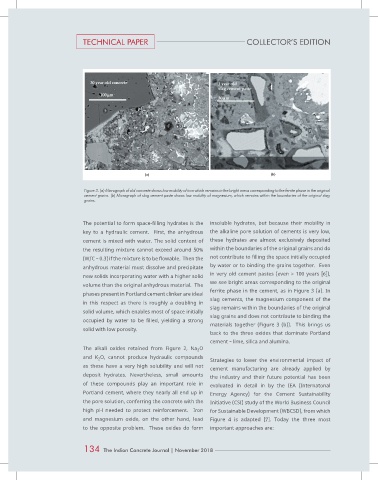
                              new solids incorporating water with a higher solid   in very old cement pastes (even > 100 years [6]),
                                                                            we see bright areas corresponding to the original
                              volume than the original anhydrous material.  The
                                                                            ferrite phase in the cement, as in Figure 3 (a). In
                              phases present in Portland cement clinker are ideal
                                                                            slag cements, the magnesium component of the
                              in this  respect as there is  roughly a doubling in
                                                                            slag remains within the boundaries of the original
                              solid volume, which enables most of space initially
                                                                            slag grains and does not contribute to binding the
                              occupied  by  water  to  be  filled,  yielding  a  strong
                                                                            materials  together  (Figure  3  (b)).    This  brings  us
                              solid with low porosity.
                                                                            back  to  the  three  oxides  that  dominate  Portland
                                                                            cement – lime, silica and alumina.
                              The  alkali  oxides  retained  from  Figure  2,  Na O
                                                                       2
                              and  K O,  cannot produce hydraulic  compounds   Strategies  to  lower  the  environmental  impact  of
                                    2
                              as these have a very high solubility  and will not   cement  manufacturing are  already  applied by
                              deposit  hydrates.  Nevertheless,  small  amounts   the industry and their future potential has been
                              of these compounds  play an important role in   evaluated  in  detail  in  by  the  IEA  (Internatonal
                              Portland cement, where they nearly all end up in   Energy  Agency)  for  the  Cement  Sustainability
                              the pore solution, conferring the concrete with the   Initiative (CSI) study of the World Business Council
                              high pH needed to protect reinforcement.  Iron   for Sustainable Development (WBCSD), from which
                              and magnesium  oxide,  on the  other  hand, lead   Figure 4 is adapted [7].  Today  the  three  most
                              to  the opposite problem.  These oxides  do form   important approaches are:


                               134 The Indian Concrete Journal | November 2018

