


Page 17 - ICJ Jan 2023
P. 17
TECHNICAL PAPER                                            COLLECTOR’S EDITION


                              At  first  glance  concrete  seems  an  unsuitable
                              material for railway sleepers. It lacks the elasticity of
                              wood, its tensile qualities differ from those of steel.
                              When steel and concrete are used for building it is
                              the steel reinforcement that takes the strain. The
                              weight of a fast-running and heavily-loaded train
                              presents, however, quite a different problem from
                              the static height of a building.


                              With ordinary reinforced concrete, when subjected
                              to tension under bending loads, small hair cracks
                              develop,  and although this  is  not  considered
                              harmful   for   ordinary  reinforced-concrete
                              structures,  it  is  harmful in  the  case  of railway
                              sleepers for main lines, as the heavy and repeated
                              loads will cause these cracks to widen and finally to
                              destroy the bond between the steel reinforcement
                              and the concrete. This damage is accelerated by
                              rain and frost.
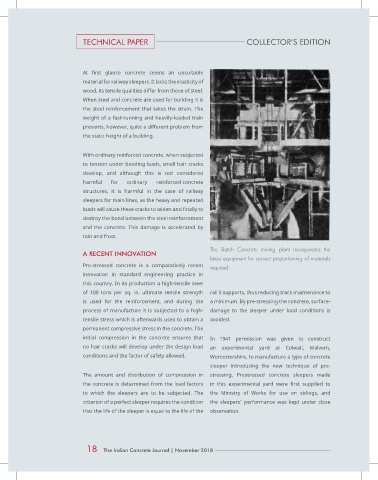
                                                                            The Batch Concrete mixing plant incorporates the
                              A RECENT INNOVATION
                                                                            latest equipment for correct proportioning of materials
                              Pre-stressed  concrete  is  a  comparatively  recent   required.
                              innovation  in standard engineering practice  in
                              this country. In its production a high-tensile steel
                              of  100  tons  per  sq.  in.  ultimate  tensile  strength   rail it supports, thus reducing track maintenance to
                              is used for the reinforcement, and during  the   a minimum. By pre-stressing the concrete, surface-
                              process of manufacture it is subjected to a high-  damage  to the sleeper under load conditions is
                              tensile stress which is afterwards used to obtain a   avoided.
                              permanent compressive stress in the concrete. The
                              initial  compression in the concrete ensures that   In  1941  permission  was  given  to  construct
                              no hair cracks will develop under the design load   an experimental yard at Colwall,  Malvern,
                              conditions and the factor of safety allowed.  Worcestershire, to manufacture a type of concrete
                                                                            sleeper  introducing  the  new  technique of pre-
                              The amount and distribution of compression  in   stressing.  Prestressed  concrete  sleepers  made
                              the concrete is determined from the load factors   in  this  experimental  yard  were  first  supplied  to
                              to  which the  sleepers  are  to  be subjected. The   the Ministry  of Works for use on sidings, and
                              criterion of a perfect sleeper requires the condition   the  sleepers’  performance was  kept  under close
                              that the life of the sleeper is equal to the life of the   observation.


                                18    The Indian Concrete Journal | November 2018

