


Page 18 - ICJ Jan 2023
P. 18
TECHNICAL PAPER                                            COLLECTOR’S EDITION


                              FIRST DELIVERY IN 1942                        tension, by means of a hand winch, to remove sag,

                              The result of the tests made in accordance with the   and then secured, also by wedges, to the movable
                              requirements of the panel of the British Standards   or jacking plate.
                              Institution,  were  studied  by  the  authority
                              concerned,  and a sleeper to give the required   The  final  tensioning  was  carried  out  by  four
                              strength for main-line  load conditions was   hydraulic  jacks  which were  inserted  between
                              designed and produced, using the same method   the steel structures of the abutments and the
                              of pre-stressing, and was supplied to the L.M.S.R.,   jacking plate; the load applied was between 60 to
                              L.N.E.R.,  G.W.R.,  and  Southern  Railway.  The  first   90 tons depending on the number of wires used
                              delivery was to the L.M.S.R. in 1942 for installation   for two  lines  of sleepers.  When  the  tension  was
                              in the fast down track at Cheddington.        obtained, the last  set of distance pieces was left
                                                                            to support the tension while the sleeper moulds
                              The Colwall yard consisted of an open concrete   were filled with concrete and during the time it set
                              apron  340  feet  long  and  30  feet  wide  with  mass   and hardened. The concrete was barrowed up to
                              concrete  abutments  at  each  end. The  abutments   the  position  of  the  sleeper  moulds,  where  it  was
                              supported the heavy steel structures, to which the   poured and vibrated, using a pneumatic vibrator
                              reinforcement wires under tension were anchored   applied at the top of the moulds.
                              during the pre-stressing process. High-tension steel
                              wire of 0.2 diameter, used in the reinforcement of   The  concrete  was  cured  for  a  period  of  10  to
                              the sleeper, was first passed through a combined   14  days,  depending  on  weather  conditions;  the
                              cleaning and straightening machine.           tension in the wires was constant for this period.


                              It  was then threaded through the individual end   The sleepers were  then detensioned. In this
                              plates  of  the  sleeper  moulds. Each mould, which   operation the hydraulic jacks were again inserted
                              consisted of an open steel trough, had at each end   between the abutment, and the movable plate: the
                              a removable end-plate holed to suit the distribution   latter was jacked out a short amount, so allowing
                              of the wires in the sleeper.                  the distance pieces to be removed and the jack
                                                                            plate to return, thus freeing the tension existing in
                              After the wires had been threaded through the end   the wires between the sleepers.
                              plates, the moulds were placed under the wires and
                              the end plates secured. During this operation the
                              wires were made off by wedges to a fixed anchor
                              plate at one end of the apron and passed through
                              a  similar,  but  movable,  plate  at  the  other  end of
                              the apron.


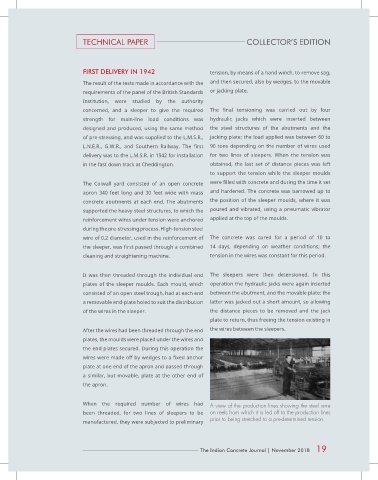
                              When the  required  number of wires  had      A view of the production lines showing the steel wire
                              been threaded, for two lines of sleepers to be   on reels from which it is led off to the production lines
                              manufactured, they were subjected to preliminary   prior to being stretched to a pre-determined tension.


                                                                        The Indian Concrete Journal | November 2018  19

