


Page 34 - ICJ Jan 2023
P. 34
TECHNICAL PAPER                                            COLLECTOR’S EDITION


                              of a calibrated finite element method developed by   The modulus of rupture for the concrete was
                                       4
                              the author . With this value for g     , equation (6)   obtained from tests on 3 in x 3 in (75 mm x 75 mm)
                              becomes                                       prisms, and 6-in (150-mm) diameter cylinders were
                                                                            used for the compressive strength tests.


                              for the specimen shown in Fig (1).


                              If the failure criterion of equation (2) is adopted,
                              then the failure moment Mc is given by,


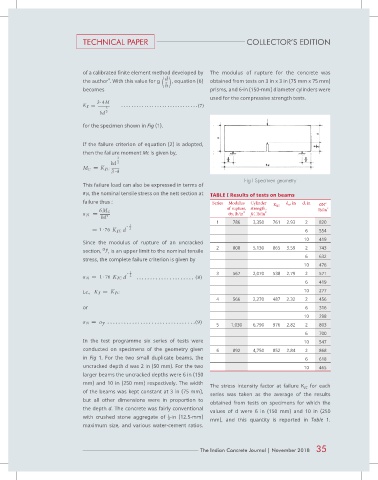
                                                                                        Fig I Specimen geometry
                              This failure load can also be expressed in terms of
                                 , the nominal tensile stress on the nett section at   TABLE I Results of tests on beams
                              failure thus :                                Series  Modulus   Cylinder   K    d , in  d, in  σN’
                                                                                                       o
                                                                                  of rupture,  strength,   IC      lb/in 2
                                                                                  σy, lb/in 2  fc’, lb/in 2
                                                                              1     786    3,350  761  2.93  2    820
                                                                                                             6    554
                                                                                                             10   419
                              Since  the  modulus  of  rupture  of  an  uncracked
                              section,   , is an upper limit to the nominal tensile   2  808   5,130   865   3.59   2   743
                              stress, the complete failure criterion is given by                             6    632
                                                                                                             10   476
                                               1                              3     567    2,070   538   2.79   2   571
                                    1 .  76  K  2                     (8)
                                N         IC d
                                                                                                             6    419
                                                                                                             10   277
                                                                              4     566    2,270   487   2.32   2   456
                              or                                                                             6    316
                                                                                                             10   298
                                                                              5    1,030   6,790   976   2.82   2   803
                                                                                                             6    700
                              In the test programme six series of tests were                                 10   547
                              conducted  on specimens of the geometry given   6     892    4,750   852   2.84   2   868
                              in  Fig  1.  For  the  two  small  duplicate  beams,  the                      6    618
                              uncracked depth d was 2 in (50 mm). For the two                                10   465
                              larger beams the uncracked depths were 6 in (150
                              mm)  and  10  in  (250 mm)  respectively.  The  width   The  stress  intensity  factor  at  failure  K   for each
                                                                                                             IC
                              of the beams was kept constant at 3 in (75 mm),   series was taken as the average of the results
                              but all  other  dimensions  were  in  proportion  to   obtained from tests  on specimens for which the
                              the depth d. The concrete was fairly conventional   values  of  d  were  6  in  (150  mm)  and  10  in  (250
                              with crushed stone aggregate of  -in  (12.5-mm)   mm),  and  this  quantity  is  reported  in  Table  1.
                              maximum  size,  and  various  water-cement  ratios.


                                                                        The Indian Concrete Journal | November 2018  35

