


Page 33 - ICJ Jan 2023
P. 33
TECHNICAL PAPER                                            COLLECTOR’S EDITION


                              where r and θ are polar co-ordinates with an origin   crack tip. If the specimen is large enough then the
                              at the crack tip.                             zone of stress disturbance can be considered to be
                                                                            surrounded by an area in which the stresses are
                              An  important  aspect  of  this  equation  is  that   substantially  in  accordance with  the  ideal  stress
                              the function  f(θ)  depends  only  on  the  material   distribution  of  the  type  given  by  equation  (1).
                              properties and not on the specimen or loading   Under these conditions, linear fracture mechanics
                              geometry. Consequently it is reasonable to    will apply. In other words, the crack propagation
                              formulate the failure criterion for crack propagation   load can be based on linear fracture mechanics if
                              in  terms  of the  load-  and geometry-dependent   the specimen is sufficiently large.
                              term  K , the stress intensity  factor. This failure
                                     I
                              criterion may be written simply as            CONCRETE FRACTURE TESTS

                                                                            Various investigators have carried out tests
                                                                            intended to  evaluate  the  fracture  toughness
                                                                            of plain concrete,  i.e.,  K  or  G IC l,2,3 . The results
                                                                                                 IC
                              where  K , the critical  stress intensity  factor, is   of these tests have generally been somewhat
                                      IC
                              a material property much the same as modulus   disappointing.  Kaplan  reported  flexural  tests  on
                              of rupture  or  crushing strength are  material   3-in (75-mm) and 6-in (150-mm) prisms containing
                              properties.                                   pre-formed cracks of various depths. The values of
                                                                            fracture toughness  determined from these tests
                              An  alternative,  but  mathematically  equivalent,   were  found  to  vary  markedly  with  specimen  size
                              failure criterion can be expressed in terms of the   and the method of evaluation. Welch encountered
                              strain energy release rate G  as              similar difficulties with flexural tests on 4-in (100-
                                                      I
                                                                            mm)  prisms  and  used  refined  experimental
                                                                            techniques to determine the amount of ‘slow crack
                                                                            growth’ during the experiments. In the discussion
                                                                            of Kaplan’s paper, Blakey and Beresford observed
                              where for plane stress
                                                                            that the failure stress based on the net section was
                                                                            consistent with the expected modulus of rupture
                                                                            for the concrete, thus casting doubt on the validity
                                                                            of the fracture mechanics approach. In this paper,
                              or for plane strain                           it  is  shown  that  the  difficulties  encountered  in
                                                                            previous tests were simply a consequence  of
                                                                            testing specimens that were too small.


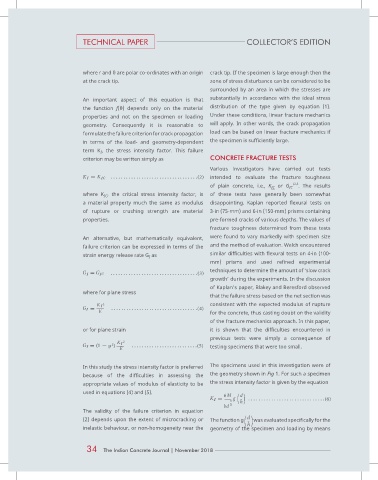
                              In this study the stress intensity factor is preferred   The specimens used in this investigation were of
                              because  of  the  difficulties  in  assessing  the   the geometry shown in Fig 1. For such a specimen
                              appropriate  values  of modulus  of elasticity  to  be   the stress intensity factor is given by the equation
                              used in equations (4) and (5).


                              The validity  of  the  failure  criterion  in  equation
                              (2) depends upon the extent of microcracking or   The function g    was evaluated specifically for the
                              inelastic behaviour, or non-homogeneity near the   geometry of the specimen and loading by means


                                34    The Indian Concrete Journal | November 2018

