


Page 28 - ICJ Jan 2023
P. 28
TECHNICAL PAPER                                            COLLECTOR’S EDITION


                              of the bridge was investigated  and found to  be  CONSTRUCTION
                              of  a  rather  minor  nature.  This  has  been  verified   The  bridge  bearings  at  pier  11  are  fixed  so  that
                                                     2
                              subsequently by  Fransen . In most  cases the   thermal movements take place over three spans.
                              lane loading governs the design; however, in the   Because  of  the  method  of  construction,  it  was
                              regions of the inflection point a check using wheel   necessary to fix the girder in stage 1 temporarily at
                              loadings was made. This condition  was never   pier 8. Upper bearing plates were offset from the
                              found to be significant.                      pier centre-line by the distance by which the girder

                                                                            would shorten during construction. Once the centre
                              The two girder webs with top and bottom flanges   pier was reached, the fixity was removed at pier 8.
                              comprise  a  large  hollow  box.  Diaphragms  36-in   With stressing of stage 3 the three-span bridge
                              (91.4-cm) thick over each pier are used to transmit   moved towards the fixed bearing, and the offsets
                              the  shear  forces  to  the  bearings.  These  are  800-  at  piers  8,  9  and  10  were  cancelled.  Subsequent
                              ton  (813-tonne)  Andre  Rotaflon  bearings  located   bearings on the south side of the centre-line were
                              at  6-ft  (182.9-cm)  centres.  A  nominal  transverse   adjusted for stressing movements.
                              prestress is supplied in each diaphragm to control
                              cracking. As shown in Fig 3 the piers are single 10-ft
                              (3.05-m) diameter shafts rising from a foundation   The temperature was assumed to vary by ± 40°F
                              supported on 12BP 74 batter piles. The underlying   (±  22.2°C)  about  a  construction  temperature
                              material  is  metamorphosed slate  overlaid  with   of 60° F (15.5°C). This is less than the normal air
                              glacial till and graded sand, gravel and clay.   temperature fluctuation in this region of Canada;
                                                                            however, the thickness of members is such that the
                                                                            response of the structure to diurnal temperatures
                                                                            is quite slow.


                                                                            The uniformity of the cross-section made
                                                                            construction  relatively  simple.  A  check  of  cable
                                                                            elongation, dynamometer readings and jack
                                                                            pressures during stressing showed that the friction
                                                                            factors used in design (µ = 0.20, K = 0.0005) were
                                                                            apparently too large.


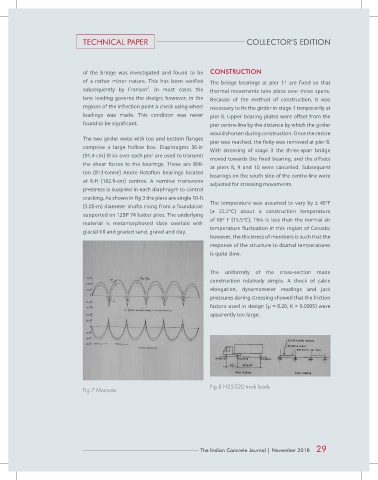
                                                                            Fig 8 H25-S20 truck loads
                              Fig 7 Moments


                                                                        The Indian Concrete Journal | November 2018  29

