


Page 26 - ICJ Jan 2023
P. 26
TECHNICAL PAPER                                            COLLECTOR’S EDITION


                              cast  and  stressed, the  statical  conditions  of each  PRESTRESSING
                              stage is changed, with the result that a succession   The  BBR  system  of  post-tensioning  is  used
                              of moments is built up in existing spans as further   throughout. Transverse cables in the deck slab and
                              spans are  completed. The net  result,  Fig  5(b),   cantilevers are tendons made of thirty-eight 7-mm
                              is that the dead load moments obtained from                                    1
                                                                                                            8
                              the summation of separate  stages         are   diameter  high  strength  steel  wires  (f   =  235,000
                                                                               2
                              different from those which might be obtained if the   lb/in ) placed radially on the bridge at about 44 in
                              bridge could be constructed as a single unit (M ).   (111.8 cm) centres.
                                                                       G
                              The general  effect  is  to  increase span moments
                              and to  diminish support moments. This elastic   The main girder reinforcing is located in the webs
                              redistribution of moments can be useful in frame   and consists of fourteen 48-wire cables which are
                              design, although it is generally difficult to predict   continuous throughout the six  spans. Cables are
                              in advance the distribution of secondary moments   coupled at the existing anchorages as a new stage
                                                1
                              in the structure. Lee  has investigated the change   is built. The post-tensioning system  used is well
                              in girder moments which result from varying   adapted to such splicing. In addition, four 38-wire
                              cantilever lengths in stage construction.
                                                                            cables extend over a portion of the span and are
                                                                            anchored through the deck. All cables are grouted,
                                                                            Fig 6(a).


                                                                            The  Canadian  Standards  Association  highway
                                                                            bridge  code,  S6-1966,  was  used  in  the  design.  At
                                                                            release, maximum wire tensions cannot exceed 0.7
                                                                                      1
                                                                             1
                                                                            f , nor 0.8 f  during the post-tensioning operation.
                                                                            8
                                                                                     8
                                                                            After all losses have occurred the wire stress shall
                                                                            not  exceed  0.6  f .  Because  of  the  large  friction
                                                                                           1
                                                                                          8
                                                                            losses  due to  the  change in  cable  direction  over
                                                                            the supports, it was necessary to stress and release
                                                                            the tendon alternately to produce a reasonably
                                                                            uniform  tension near the stressing end.  Fig  6(b)
                                                                            shows the general prestressing force distribution
                                                                            in stage 1.

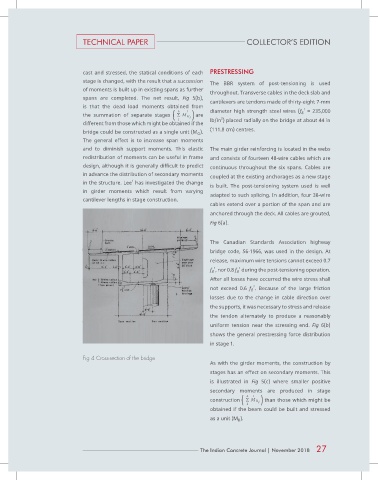
                              Fig 4 Cross-section of the bridge
                                                                            As  with  the  girder moments,  the  construction  by
                                                                            stages has an effect on secondary moments. This
                                                                            is illustrated in  Fig  5(c)  where  smaller  positive
                                                                            secondary moments are produced in stage
                                                                            construction       than those which might be
                                                                            obtained if the beam could be built and stressed
                                                                            as a unit (M ).
                                                                                     R


                                                                        The Indian Concrete Journal | November 2018  27

