


Page 25 - ICJ Jan 2023
P. 25
TECHNICAL PAPER                                            COLLECTOR’S EDITION


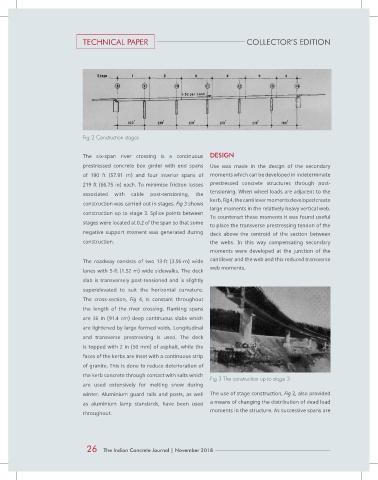
                              Fig 2 Construction stages


                              The six-span river crossing is a continuous  DESIGN
                              prestressed concrete box girder with end spans   Use  was  made  in  the  design  of  the  secondary
                              of  190  ft  (57.91  m)  and  four  interior  spans  of   moments which can be developed in indeterminate
                              219 ft (66.75 in) each. To minimise friction losses   prestressed  concrete  structures  through post-
                              associated  with  cable  post-tensioning,  the  tensioning. When wheel loads are adjacent to the
                                                                            kerb, Fig 4, the cantilever moments developed create
                              construction was carried out in stages. Fig 3 shows
                                                                            large moments in the relatively heavy vertical web.
                              construction up to stage 3. Splice points between
                                                                            To counteract these moments it was found useful
                              stages were located at 0.2 of the span so that some   to place the transverse prestressing tendon of the
                              negative support moment was generated during   deck above  the centroid of the section  between
                              construction.                                 the webs. In this  way compensating secondary
                                                                            moments  were  developed  at  the  junction  of  the
                              The  roadway  consists  of  two  13-ft  (3.96-m)  wide   cantilever and the web and this reduced transverse
                                                                            web moments.
                              lanes with 5-ft (1.52 m) wide sidewalks. The deck
                              slab is transversely post-tensioned and is slightly
                              superelevated  to  suit  the  horizontal  curvature.

                              The cross-section,  Fig 4,  is  constant throughout
                              the  length  of  the  river  crossing.  Flanking spans
                              are  36  in  (91.4  cm)  deep  continuous  slabs  which
                              are lightened by large formed voids. Longitudinal
                              and transverse  prestressing  is  used. The  deck
                              is topped with 2 in (50 mm) of asphalt, while the
                              faces of the kerbs are inset with a continuous strip
                              of granite. This is done to reduce deterioration of
                              the kerb concrete through contact with salts which
                                                                            Fig 3 The construction up to stage 3
                              are used extensively  for melting snow during
                              winter.  Aluminium  guard  rails  and  posts,  as  well   The use of stage construction, Fig 2, also provided

                              as  aluminium  lamp standards, have  been used   a means of changing the distribution of dead load
                                                                            moments in the structure. As successive spans are
                              throughout.


                                26    The Indian Concrete Journal | November 2018

