


Page 27 - ICJ Jan 2023
P. 27
TECHNICAL PAPER                                            COLLECTOR’S EDITION


                              It  would appear that  there  is  a  great  divergence
                              between the values of girder secondary moments
                              in  stage  construction  compared  with  those  of
                              the bridge built and stressed as a single unit.
                              The property of concrete creep, however, is such
                              that the secondary moments obtained in stage
                              construction  tend to  creep  towards those  values
                              which would be obtained through construction
                              as  a  unit.  These  will  approach  within  (1—e —ɸ )  of
                              each other. For design it was impossible to know
                              the time between the construction of each stage
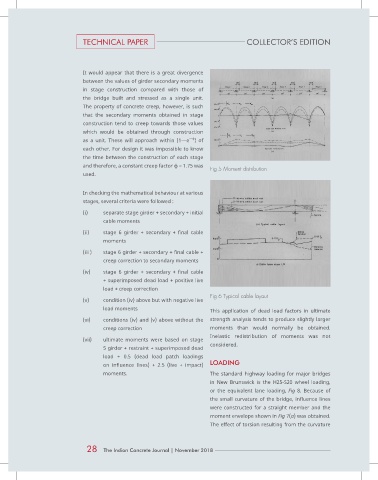
                              and therefore, a constant creep factor ɸ = 1.75 was   Fig 5 Moment distribution
                              used.


                              In checking the mathematical behaviour at various
                              stages, several criteria were followed :
                              (i)       separate stage girder + secondary + initial
                                      cable moments

                              (ii)      stage  6  girder  +  secondary  +  final  cable
                                      moments

                              (iii )     stage 6 girder + secondary + final cable +
                                      creep correction to secondary moments
                              (iv)      stage  6  girder  +  secondary  +  final  cable
                                      + superimposed dead load + positive live
                                      load + creep correction
                                                                            Fig 6 Typical cable layout
                              (v)       condition (iv) above but with negative live
                                      load moments                          This  application  of  dead load  factors  in  ultimate
                              (vi)      conditions (iv) and (v) above without the   strength analysis tends to produce slightly larger
                                      creep correction                      moments than would normally  be obtained.
                                                                            Inelastic  redistribution  of moments  was not
                              (vii)     ultimate  moments  were  based  on  stage
                                      5 girder + restraint + superimposed dead   considered.
                                      load  +  0.5  (dead  load  patch  loadings
                                      on  influence  lines)  +  2.5  (live  +  impact)   LOADING
                                      moments.                              The standard highway loading for major bridges
                                                                            in  New  Brunswick  is  the  H25-S20  wheel  loading,
                                                                            or the equivalent lane loading,  Fig  8.  Because  of
                                                                            the small curvature of the bridge, influence lines
                                                                            were constructed for a straight member and the
                                                                            moment envelope shown in Fig 7(a) was obtained.
                                                                            The effect of torsion resulting from the curvature


                                28    The Indian Concrete Journal | November 2018

