


Page 35 - ICJ Jan 2023
P. 35
TECHNICAL PAPER                                            COLLECTOR’S EDITION


                              Also  included  in  this  table  are  the  results  of  the   be negligible, and failure loads are consistent with
                              companion modulus of  rupture  and compressive   the modulus of rupture on the nett section. It may
                              strength tests, and the nominal failure stress on   also be concluded that concrete members may be
                              the  nett section, and for the  cracked specimens,   notch insensitive  for small  laboratory  specimens,
                              the computed value of d for which equations (8)   but susceptible to crack propagation for structural-
                                                    o
                              and (9) intersect for each series.            sized  members.  This  effect  may  influence  the
                                                                            application  to  structural  members of laboratory

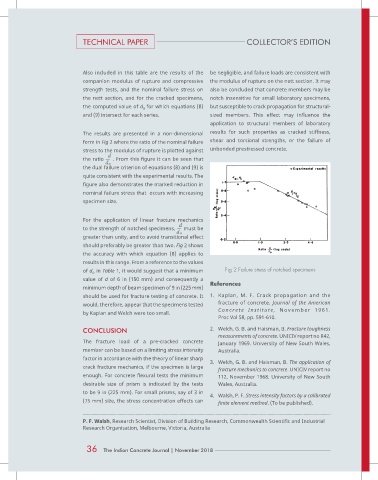
                              The results  are  presented  in  a  non-dimensional   results for such properties as cracked stiffness,
                              form in Fig 2 where the ratio of the nominal failure   shear and torsional  strengths, or the failure of
                              stress to the modulus of rupture is plotted against   unbonded prestressed concrete.
                              the ratio    . From this figure it can be seen that
                              the dual failure criterion of equations (8) and (9) is
                              quite consistent with the experimental results. The
                              figure also demonstrates the marked reduction in
                              nominal failure stress that  occurs with increasing
                              specimen size.


                              For the application of linear fracture mechanics
                              to the strength of notched specimens,    must be
                              greater than unity, and to avoid transitional effect
                              should preferably be greater than two. Fig 2 shows
                              the  accuracy  with  which  equation  (8)  applies  to
                              results in this range. From a reference to the values
                              of d  in Table 1, it would suggest that a minimum   Fig 2 Failure stress of notched specimens
                                  o
                              value  of  d  of  6  in  (150  mm)  and  consequently  a
                              minimum depth of beam specimen of 9 in (225 mm)   References
                              should be used for fracture testing of concrete. It   1.  Kaplan,  M.  F.  Crack  propagation  and  the
                              would, therefore, appear that the specimens tested   fracture of concrete.  Journal of the American
                              by Kaplan and Welch were too small.             C o ncr e t e   Insti t ut e ,   N ov e m be r   1 9 6 1 .
                                                                              Proc Vol 58, pp. 591-610.
                              CONCLUSION                                    2.  Welch, G. B. and Haisman, B. Fracture toughness
                                                                              measurements of concrete. UNICIV report no R42,
                              The fracture load of a pre-cracked concrete     January 1969. University of New South Wales,
                              member can be based on a limiting stress intensity   Australia.
                              factor in accordance with the theory of linear sharp   3.  Welch, G. B. and Haisman, B. The application of
                              crack fracture mechanics, if the specimen is large   fracture mechanics to concrete. UNICIV report no
                              enough. For concrete flexural tests the minimum   112, November 1968. University of New South
                              desirable  size  of  prism  is  indicated  by  the  tests   Wales, Australia.
                              to be 9 in (225 mm). For small prisms, say of 3 in     4.  Walsh, P. F. Stress intensity factors by a calibrated
                              (75 mm) size, the stress concentration effects can   finite element method. (To be published).


                              P. F. Walsh, Research Scientist, Division of Building Research, Commonwealth Scientific and Industrial
                              Research Organisation, Melbourne, Victoria, Australia


                                36    The Indian Concrete Journal | November 2018

