


Page 17 - Open-Access-Sep-2019
P. 17
TECHNICAL PAPER


         2.2 Methodology
         2.2.1 Printing Procedure
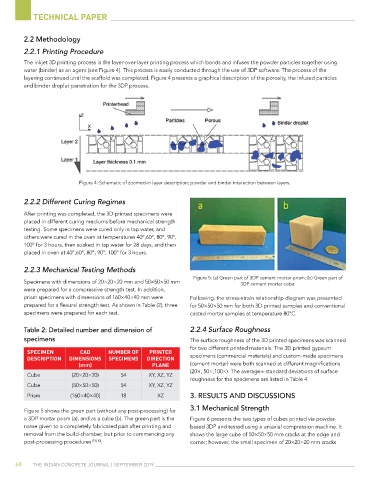
         The inkjet 3D printing process is the layer-over-layer printing process which bonds and infuses the powder particles together using
         water (binder) as an agent (see Figure 4). This process is easily conducted through the use of 3DP software. The process of the
         layering continued until the scaffold was completed. Figure 4 presents a graphical description of the porosity, the infused particles
         and binder droplet penetration for the 3DP process.


                           Figure 4: Schematic of zoomed-in layer description; powder and binder interaction between layers.


         2.2.2 Different Curing Regimes
         After printing was completed, the 3D printed specimens were
         placed in different curing mediums before mechanical strength
         testing. Some specimens were cured only in tap water, and
         others were cured in the oven at temperatures 40°,60°, 80°, 90°,
         100° for 3 hours, then soaked in tap water for 28 days, and then
         placed in oven at 40°,60°, 80°, 90°, 100° for 3 hours.


         2.2.3 Mechanical Testing Methods
                                                                 Figure 5: (a) Green part of 3DP cement mortar prism; (b) Green part of
         Specimens with dimensions of 20×20×20 mm and 50×50×50 mm                3DP cement mortar cube.
         were prepared for a compressive strength test. In addition,
         prism specimens with dimensions of 160×40×40 mm were   Following, the stress-strain relationship diagram was presented
         prepared for a flexural strength test. As shown in Table (2), three   for 50×50×50 mm for both 3D printed samples and conventional
         specimens were prepared for each test.                 casted mortar samples at temperature 80°C.


         table 2: Detailed number and dimension of              2.2.4 Surface Roughness
         specimens                                              The surface roughness of the 3D printed specimens was scanned
                                                                for two different printed materials. The 3D printed gypsum
          sPEcIMEn          cAD      nUMbEr of    PrIntED
          DEscrIPtIon   DIMEnsIons   sPEcIMEns    DIrEctIon     specimens (commercial materials) and custom-made specimens
                           (mm)                    PlAnE        (cement mortar) were both scanned at different magnifications
                                                                (20×, 50×,100×). The average± standard deviations of surface
          Cube           (20×20×20)      54       XY, XZ, YZ
                                                                roughness for the specimens are listed in Table 4.
          Cube           (50×50×50)      54       XY, XZ, YZ
          Prism         (160×40×40)      18          XZ         3. rESultS anD DiSCuSSionS

         Figure 5 shows the green part (without any post-processing) for   3.1 Mechanical Strength
         a 3DP mortar prism (a), and as a cube (b). The green part is the   Figure 6 presents the two types of cubes printed via powder-
         name given to a completely fabricated part after printing and   based 3DP and tested using a uniaxial compression machine. It
         removal from the build-chamber, but prior to commencing any   shows the large cube of 50×50×50 mm cracks at the edge and
         post-processing procedures  [9] [10] .                 corner; however, the small specimen of 20×20×20 mm cracks


      68    The IndIan ConCreTe Journal | SepTember 2019

