


Page 19 - Open-Access-Sep-2019
P. 19
TECHNICAL PAPER


         In general, curing in tap water achieves low compressive   however, the opposite is the case for conventional cast
         strength test results, predominantly due to the slight reaction   specimens. This phenomenon could be due to better flowability
         that occurs among particles. The low compressive strength   from the feeder tank and better compaction on the build-
         results occurred when the printed specimens were placed   chamber for the bigger specimens. The feeder tank contains
         directly in water, resulting in most of the unreacted particles   a rotor motor which is in the middle of the printer. Therefore,
         becoming detached from the printed part and weak bonds   the powders for the bigger specimens deposit from the middle
         breaking, as found in the study by . The small concentration   of the feeder tank with greater homogeneity and fewer voids
                                     [9]
         of OH- ions in tap water works as a reactive chemical agent in   between particles. This results in a better deposition of powder
         the cementitious process since it leads to ineffective dissolution   and more powder flowing from the feeder. When the powders
         and formation of hydroxyl substances  [27] [28] . Consequently, low   have more particles in the feeder chamber, the result is that the
         compressive strength will occur due to the densify reaction not   roller spreads more powder on the build-chamber. The more
         being established appropriately. In addition, it must be noted   particle powders on the build-chamber allow them to be more
         that water curing at very high temperatures adversely affects   effectively compacted.
         compressive strength, due to heat acceleration, which leads
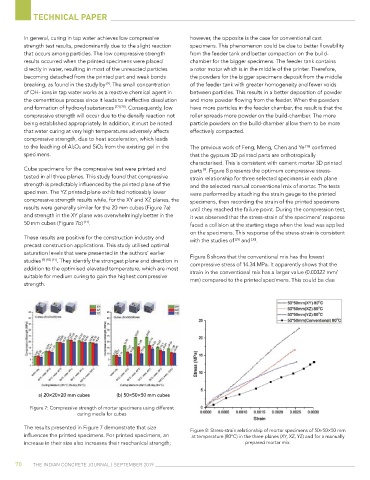
         to the leaching of Al 2O 3 and SiO 2 from the existing gel in the   The previous work of Feng, Meng, Chen and Ye  [16]  confirmed
         specimens.                                             that the gypsum 3D printed parts are orthotropically
                                                                characterised. This is consistent with cement mortar 3D printed
         Cube specimens for the compressive test were printed and   parts . Figure 8 presents the optimum compressive stress-
                                                                     [9]
         tested in all three planes. This study found that compressive   strain relationship for three selected specimens in each plane
         strength is predictably influenced by the printed plane of the   and the selected manual conventional mix of mortar. The tests
         specimen. The YZ printed plane exhibited noticeably lower   were performed by attaching the strain gauge to the printed
         compressive strength results while, for the XY and XZ planes, the   specimens, then recording the strain of the printed specimens
         results were generally similar for the 20 mm cubes (Figure 7a)   until they reached the failure point. During the compression test,
         and strength in the XY plane was overwhelmingly better in the   it was observed that the stress-strain of the specimens’ response
         50 mm cubes (Figure 7b)  [11] .                        faced a collision at the starting stage when the load was applied
                                                                on the specimens. This response of the stress-strain is consistent
         These results are positive for the construction industry and   with the studies of  [29]  and  [30] .
         precast construction applications. This study utilised optimal
         saturation levels that were presented in the authors’ earlier   Figure 8 shows that the conventional mix has the lowest
         studies  [9] [10] [11] . They identify the strongest plane and direction in   compressive stress of 14.34 MPa. It apparently shows that the
         addition to the optimised elevated temperature, which are most   strain in the conventional mix has a larger value (0.00322 mm/
         suitable for medium curing to gain the highest compressive   mm) compared to the printed specimens. This could be due
         strength.


              a) 20×20×20 mm cubes      (b) 50×50×50 mm cubes

           Figure 7: Compressive strength of mortar specimens using different
                           curing media for cubes

         The results presented in Figure 7 demonstrate that size   Figure 8: Stress-strain relationship of mortar specimens of 50×50×50 mm
         influences the printed specimens. For printed specimens, an   at temperature (80°C) in the three planes (XY, XZ, YZ) and for a manually
         increase in their size also increases their mechanical strength;         prepared mortar mix.


      70    The IndIan ConCreTe Journal | SepTember 2019

