


Page 23 - Open-Access-Sep-2019
P. 23
TECHNICAL PAPER


             acid binder: fabrication, microstructure and in situ X-Ray   on the thermal behavior and mechanical performance of
             tomography analysis of compressive failure, Journal of   fly ash geopolymer paste, mortar and lightweight concrete,
             Materials Science: Materials in Medicine 29(3) (2018) 29.  Construction and Building Materials 50 (2014) 377-387.
         [31]  J.M.L.d. Reis, Effect of temperature on the mechanical   [34]  BiolinScientific, Influence of surface roughness on contact
             properties of polymer mortars, Materials Research 15(4)   angle and wettability.
             (2012) 645-649.                                    [35]  P. Chindaprasirt, S. Rukzon, Strength, porosity and corrosion
         [32]  ASTMC293/C293M, 293 Standard Test Method for Flexural   resistance of ternary blend Portland cement, rice husk ash
             Strength of Concrete (Using Simple Beam With Center-   and fly ash mortar, Construction and Building Materials 22(8)
             Point Loading), ASTM Standard  (2002).                 (2008) 1601-1606.
         [33]  O.A. Abdulkareem, A.M. Mustafa Al Bakri, H. Kamarudin, I.   [36]  S. Kandasami, Sustainable Construction: Responsible Use of
             Khairul Nizar, A.e.A. Saif, Effects of elevated temperatures   Materials, The Indian Concrete Journal (2019) 9-13.


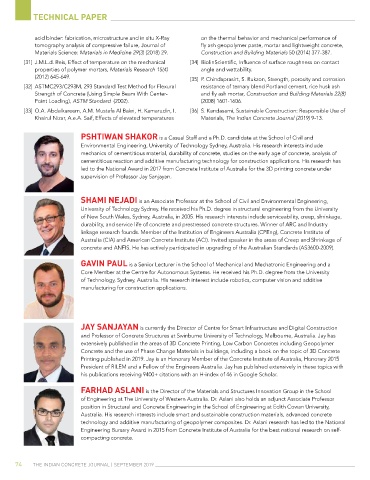
                            PshtIwAn shAkor is a Casual Staff and a Ph.D. candidate at the School of Civil and
                            Environmental Engineering, University of Technology Sydney, Australia. His research interests include
                            mechanics of cementitious material, durability of concrete, studies on the early age of concrete, analysis of
                            cementitious reaction and additive manufacturing technology for construction applications. His research has
                            led to the National Award in 2017 from Concrete Institute of Australia for the 3D printing concrete under
                            supervision of Professor Jay Sanjayan.


                            shAMI nEJADI is an Associate Professor at the School of Civil and Environmental Engineering,
                            University of Technology Sydney. He received his Ph.D. degree in structural engineering from the University
                            of New South Wales, Sydney, Australia, in 2005. His research interests include serviceability, creep, shrinkage,
                            durability, and service life of concrete and prestressed concrete structures. Winner of ARC and Industry
                            linkage research founds. Member of the Institution of Engineers Australia (CPEng), Concrete Institute of
                            Australia (CIA) and American Concrete Institute (ACI). Invited speaker in the areas of Creep and Shrinkage of
                            concrete and ANFIS. He has actively participated in upgrading of the Australian Standards (AS3600-2009).


                            gAvIn PAUl is a Senior Lecturer in the School of Mechanical and Mechatronic Engineering and a
                            Core Member at the Centre for Autonomous Systems. He received his Ph.D. degree from the University
                            of Technology, Sydney, Australia. His research interest include robotics, computer vision and additive
                            manufacturing for construction applications.


                            JAy sAnJAyAn is currently the Director of Centre for Smart Infrastructure and Digital Construction
                            and Professor of Concrete Structures at Swinburne University of Technology, Melbourne, Australia. Jay has
                            extensively published in the areas of 3D Concrete Printing, Low Carbon Concretes including Geopolymer
                            Concrete and the use of Phase Change Materials in buildings, including a book on the topic of 3D Concrete
                            Printing published in 2019. Jay is an Honorary Member of the Concrete Institute of Australia, Honorary 2015
                            President of RILEM and a Fellow of the Engineers Australia. Jay has published extensively in these topics with
                            his publications receiving 9400+ citations with an H-index of 46 in Google Scholar.


                            fArhAD AslAnI is the Director of the Materials and Structures Innovation Group in the School
                            of Engineering at The University of Western Australia. Dr. Aslani also holds an adjunct Associate Professor
                            position in Structural and Concrete Engineering in the School of Engineering at Edith Cowan University,
                            Australia. His research interests include smart and sustainable construction materials, advanced concrete
                            technology and additive manufacturing of geopolymer composites. Dr. Aslani research has led to the National
                            Engineering Bursary Award in 2015 from Concrete Institute of Australia for the best national research on self-
                            compacting concrete.


      74    The IndIan ConCreTe Journal | SepTember 2019

