


Page 21 - Open-Access-Sep-2019
P. 21
TECHNICAL PAPER


                                                                Construction and demolition recycling wastes have potential
                                                                for use in the powder-based 3DP technique. For example,
                                                                Kandasami  [36]  stated that the construction industry in India
                                                                produces 50 million tonnes of waste and that 50% of that
                                                                waste could be recycled. After crushing waste to powder and
                                                                small particles, this could be utilised in a powder-based 3DP
                                                                technique for construction applications. The recycled wastes are
                                                                easy to convert into powder, which can then be used in a printer.
                                                                Later, the print command could replicate thousands of objects
                                                                according to the CAD model. In future, as technology advances,
                                                                the powder-based 3DP technique could be developed into a
                                                                single machine that not only works such as a crusher but also
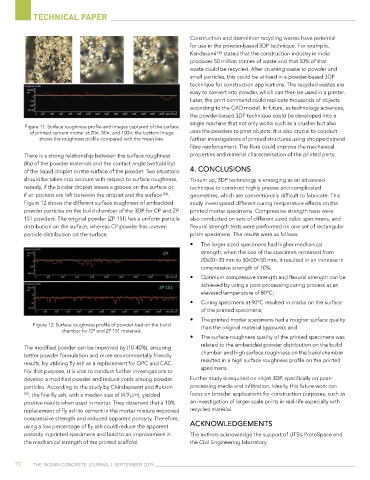
         Figure 11: Surface roughness profile and images captured of the surface
           of printed cement mortar at 20×, 50×, and 100×; the bottom image   uses the powders to print objects. It is also crucial to conduct
              shows the roughness profile compared with the mean line.  further investigations of printed structures using chopped strand
                                                                fibre reinforcement. The fibre could improve the mechanical
         There is a strong relationship between the surface roughness   properties and material characterisation of the printed parts.
         (Ra) of the powder materials and the contact angle (wettability)
         of the liquid droplet on the surface of the powder. Two situations   4. coNclUsIoNs
         should be taken into account with respect to surface roughness,   To sum up, 3DP technology is emerging as an advanced
         namely, if the binder droplet leaves a groove on the surface or   technique to construct highly precise and complicated
         if air pockets are left between the droplet and the surface  [33] .   geometries, which are conventionally difficult to fabricate. This
         Figure 12 shows the different surface roughness of embedded   study investigated different curing temperature effects on the
         powder particles on the build chamber of the 3DP for CP and ZP   printed mortar specimens. Compressive strength tests were
         151 powders. The original powder (ZP 151) has a uniform particle   also conducted on sets of different sized cubic specimens, and
         distribution on the surface, whereas CP powder has uneven   flexural strength tests were performed on one set of rectangular
         particle distribution on the surface.                  prism specimens. The results were as follows:
                                                                •   The larger sized specimens had higher mechanical
                                                                   strength, when the size of the specimen increased from
                                                                   20x20×20 mm to 50x50×50 mm, it resulted in an increase in
                                                                   compressive strength of 10%;
                                                                •   Optimum compressive strength and flexural strength can be
                                                                   achieved by using a post-processing curing process at an
                                                                   elevated temperature of 80°C;
                                                                •   Curing specimens at 90°C resulted in cracks on the surface
                                                                   of the printed specimens;
                                                                •   The printed mortar specimens had a rougher surface quality
            Figure 12: Surface roughness profile of powder-bed on the build   than the original material (gypsum); and
                     chamber for CP and ZP 151 materials.
                                                                •   The surface roughness quality of the printed specimens was
                                                                   related to the embedded powder distribution on the build
         The modified powder can be improved by (10-40%), ensuring
         better powder formulation and more environmentally friendly   chamber and high surface roughness on the build chamber
         results, by utilising fly ash as a replacement for OPC and CAC.   resulted in a high surface roughness profile on the printed
         For that purpose, it is vital to conduct further investigations to   specimens.
         develop a modified powder and reduce voids among powder   Further study is required on inkjet 3DP, specifically on post-
         particles. According to the study by Chindaprasirt and Rukzon    processing media and infiltration. Ideally, this future work can
         [35] , the fine fly ash, with a median size of (4.9 µm), yielded   focus on broader applications for construction purposes, such as
         positive results when used in mortar. They observed that a 10%   an investigation of larger-scale prints in real-life especially with
         replacement of fly ash to cement in the mortar mixture improved   recycled material.
         compressive strength and reduced apparent porosity. Therefore,
         using a low percentage of fly ash could reduce the apparent   aCknowlEDgEMEntS
         porosity in printed specimens and lead to an improvement in   The authors acknowledge the support of UTS’s ProtoSpace and
         the mechanical strength of the printed scaffold.       the Civil Engineering laboratory.


      72    The IndIan ConCreTe Journal | SepTember 2019

