


Page 18 - Open-Access-Sep-2019
P. 18
TECHNICAL PAPER


         from the mid-top to mid-bottom of the cube (see Figure 6). The   been repeatedly observed, even at 91 days, for cement mortar
         nature of the failure and cracking in the specimen are clues to   at temperatures of 60°C  [23] .
         the stiffness of the printed scaffold. The large specimen would
         not crack and break easily through the middle of the specimen,   Raised temperature increases the rate of reaction and reduces
         whereas, the small printed structure cracked at the corner of the   the setting time  [10]  since it accelerates the dissolving of alumina
         specimen and broke easily in the middle of the specimen.  and silica particles from the unreacted particles of the powder
                                                                and a larger amount of Alumina (Al 2O 3) and Silica(SiO 2) becomes
                                                                available for the reaction process. The modified powder for
                                                                3DP contains a high proportion of Alumina due to the high
                                                                levels of CAC in the main powder. In relation to the total mass,
                                                                Al 2O 3 comprises approximately 70% in CAC whereas, in general
                                                                purpose cement (OPC), it comprises 5%.


                                                                The possibility of delayed ettringite formation is a risk that
                                                                should be considered due to early hydration. Ettringite
                                                                (3CaO•Al 2O 3•3CaSO 4•32H 2O) is a mineral called calcium
                                                                sulfoaluminate  [24] . It results from the reaction between gypsum
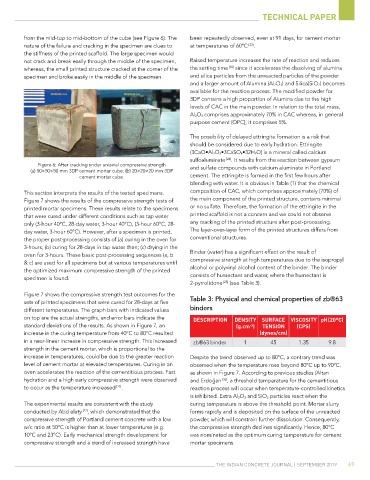
              Figure 6: After cracking under uniaxial compressive strength    and sulfate compounds with calcium aluminate in Portland
           (a) 50×50×50 mm 3DP cement mortar cube; (b) 20×20×20 mm 3DP
                           cement mortar cube.                  cement. The ettringite is formed in the first few hours after
                                                                blending with water. It is obvious in Table (1) that the chemical
         This section interprets the results of the tested specimens.   composition of CAC, which comprises approximately (70%) of
         Figure 7 shows the results of the compressive strength tests of   the main component of the printed structure, contains minimal
         printed mortar specimens. These results relate to the specimens   or no sulfate. Therefore, the formation of the ettringite in the
         that were cured under different conditions such as tap water   printed scaffold is not a concern and we could not observe
         only (3-hour 40°C, 28-day water, 3-hour 40°C), (3-hour 60°C, 28-  any cracking of the printed structure after post-processing.
         day water, 3-hour 60°C). However, after a specimen is printed,   The layer-over-layer form of the printed structures differs from
         the proper post-processing consists of (a) curing in the oven for   conventional structures.
         3-hours; (b) curing for 28-days in tap water then; (c) drying in the
         oven for 3-hours. These basic post-processing sequences (a, b   Binder (water) has a significant effect on the result of
         & c) are used for all specimens but at various temperatures until   compressive strength at high temperatures due to the isopropyl
         the optimized maximum compressive strength of the printed   alcohol or polyvinyl alcohol content of the binder. The binder
         specimen is found.                                     consists of humectant and water, where the humectant is
                                                                2-pyrrolidone  [25]  (see Table 3).
         Figure 7 shows the compressive strength test outcomes for the
         sets of printed specimens that were cured for 28-days at five   table 3: physical and chemical properties of zb®63
         different temperatures. The graph bars with indicated values   binders
         on top are the actual strengths, and error bars indicate the   DEscrIPtIon  DEnsIty  sUrfAcE  vIscosIty  ph(20°c)
         standard deviations of the results. As shown in Figure 7, an          (g.cm )  tEnsIon    (cPs)
                                                                                    -3
         increase in the curing temperature from 40°C to 80°C resulted                 (dynes/cm)
         in a near-linear increase in compressive strength. This increased   zb®63 binder  1  45    1.35      9.8
         strength in the cement mortar, which is proportional to the
         increase in temperatures, could be due to the greater reaction   Despite the trend observed up to 80°C, a contrary trend was
         level of cement mortar at elevated temperatures. Curing in an   observed when the temperature rose beyond 80°C up to 90°C,
         oven accelerates the reaction of the cementitious process. Fast   as shown in Figure 7. According to previous studies (Altan
         hydration and a high early compressive strength were observed   and Erdoğan  [26] , a threshold temperature for the cementitious
         to occur as the temperature increased  [21] .          reaction process will occur when temperature-controlled kinetics
                                                                is inhibited. Extra Al 2O 3 and SiO 2 particles react when the
         The experimental results are consistent with the study   curing temperature is above the threshold point. Mortar slurry
         conducted by Abd elaty  [22] , which demonstrated that the   forms rapidly and is deposited on the surface of the unreacted
         compressive strength of Portland cement concrete with a low   powder, which will constrain further dissolution. Consequently,
         w/c ratio at 50°C is higher than at lower temperatures (e.g.   the compressive strength declines significantly. Hence, 80°C
         10°C and 23°C). Early mechanical strength development for   was nominated as the optimum curing temperature for cement
         compressive strength and a trend of increased strength have   mortar specimens.


                                                                         The IndIan ConCreTe Journal | SepTember 2019  69

