


Page 20 - Open-Access-Sep-2019
P. 20
TECHNICAL PAPER


         to the higher density of the specimens in the conventional   paste experienced the highest strength loss as the temperature
         mix than the printed mix. The density of the printed object   increased. The best result was at (70°C)  [33] . The results of the
                                   3
         was approximately 0.0017 g/mm  which was recorded for the   Abdulkareem, Mustafa Al Bakri, Kamarudin, Khairul Nizar
         highest saturation level, whereas the density of the conventional   and Saif  [33]  are consistent with that of the presented study for
         mix was approximately 0.0021 g/mm . According to Reis  [31] ,   cement mortar-based 3DP objects, which were tested at various
                                      3
         the mechanical strength of the polymer mortar specimens was   temperatures.
         reduced by 50% when temperature increased to 80°C. In our
         study, this was the case for conventional mortar specimens but
         not for printed specimens. Reis  [31]  observed that strain had a
         higher value at 80°C than for other curing temperatures, similar
         to the experimental work conducted in this research.

         The prism specimens were prepared and subjected to the three-
         point bending test  [32] . The size of the specimens was chosen
         based on the conventional standard prism for mortar, namely,
         160×40×40 mm.

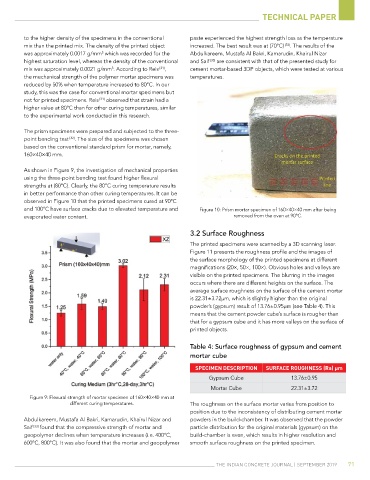
         As shown in Figure 9, the investigation of mechanical properties
         using the three-point bending test found higher flexural
         strengths at (80°C). Clearly, the 80°C curing temperature results
         in better performance than other curing temperatures. It can be
         observed in Figure 10 that the printed specimens cured at 90°C
         and 100°C have surface cracks due to elevated temperature and   Figure 10: Prism mortar specimen of 160×40×40 mm after being
         evaporated water content.                                            removed from the oven at 90°C.


                                                                3.2 Surface roughness
                                                                The printed specimens were scanned by a 3D scanning laser.
                                                                Figure 11 presents the roughness profile and the images of
                                                                the surface morphology of the printed specimens at different
                                                                magnifications (20×, 50×, 100×). Obvious holes and valleys are
                                                                visible on the printed specimens. The blurring in the images
                                                                occurs where there are different heights on the surface. The
                                                                average surface roughness on the surface of the cement mortar
                                                                is 22.31±3.72µm, which is slightly higher than the original
                                                                powder’s (gypsum) result of 13.76±0.95µm (see Table 4). This
                                                                means that the cement powder cube’s surface is rougher than
                                                                that for a gypsum cube and it has more valleys on the surface of
                                                                printed objects.


                                                                table 4: surface roughness of gypsum and cement
                                                                mortar cube
                                                                  sPEcIMEn DEscrIPtIon   sUrfAcE roUghnEss (ra) µm
                                                                      Gypsum Cube                13.76±0.95
                                                                       Mortar Cube               22.31±3.72
           Figure 9: Flexural strength of mortar specimen of 160×40×40 mm at
                        different curing temperatures.          The roughness on the surface mortar varies from position to
                                                                position due to the inconsistency of distributing cement mortar
         Abdulkareem, Mustafa Al Bakri, Kamarudin, Khairul Nizar and   powders in the build-chamber. It was observed that the powder
         Saif  [33]  found that the compressive strength of mortar and   particle distribution for the original materials (gypsum) on the
         geopolymer declines when temperature increases (i.e. 400°C,   build-chamber is even, which results in higher resolution and
         600°C, 800°C). It was also found that the mortar and geopolymer   smooth surface roughness on the printed specimen.


                                                                         The IndIan ConCreTe Journal | SepTember 2019  71

